What are the driving hazards on the single-lane road from Sacaycacha to Pallasca?
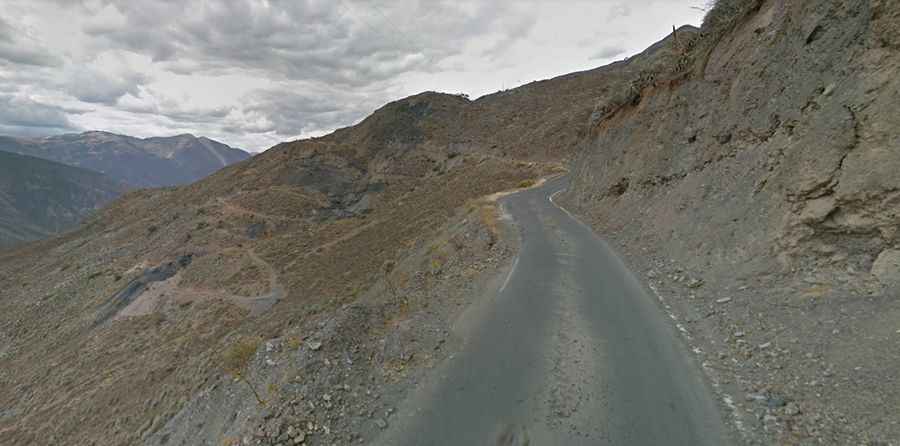
The Carretera Sacaycacha-Pallasca, located in the Pallasca Province of the Ancash region in Peru, is one of the most high-risk routes in the Andes. Spanning 17.8 km (11 miles), this road is defined by its extreme verticality, lack of protections, and a technically challenging mixed-surface composition of asphalt and dirt sections. For any driver, this single-lane corridor is a definitive test of technical skill and psychological endurance, as it traverses terrain with unprotected drops exceeding 600 meters (2,000ft).
| Road facts: Sacaycacha to Pallasca | |
|---|---|
| Location | Ancash Region, Peru |
| Length | 17.8 km (11 miles) |
| Elevation Gain | 1,234 meters (4,048 ft) |
| Average Gradient | 6.93% (Max 10.2%) |
| Surface | Asphalt and Dirt (Impassable when wet) |
How does the mixed surface affect the logistics between Sacaycacha and Pallasca?
Technically, the road is an extremely narrow, single-lane corridor serving two-way traffic. While parts are asphalted, significant sections remain unpaved, consisting of native dirt that becomes impassable during weather events. This surface volatility requires constant forward scanning for oncoming traffic and the use of the few available widening points. Starting from Sacaycacha at 1,850m, the road climbs 1,234 meters over 100 technical turns. The 17.8 km stretch features sustained gradients with a maximum slope of 10.2%, requiring precise throttle control on the unpaved ramps to prevent tire slip while navigating the cliff-side curves.
What are the primary safety risks in the Ancash high-altitude environment?
The road has a well-deserved reputation for being dangerous due to its combination of severe drops and unpredictable weather. The presence of dirt sections means that snowstorms, blizzards, or heavy rain can instantly turn the unpaved ramps into low-friction hazards. Safety protocols mandate staying away from this route if you suffer from vertigo, as the 600-meter drops are completely unprotected by guardrails. Furthermore, the **unpredictable nature of landslides** in the Ancash region is exacerbated on the dirt sections, where erosion frequently compromises the stability of the narrow roadbed.
What are the mechanical requirements for the Pallasca ascent and descent?
The 6.93% average gradient, combined with the 100 hairpins, places a significant thermal load on the vehicle’s braking and cooling systems. Technically, the dirt sections add a suspension articulation challenge, requiring high-clearance to avoid underbody damage. Logistically, drivers must be prepared for extreme isolation; there is no recovery infrastructure between the two towns. Ensuring that the vehicle’s tire sidewall integrity and braking systems are in optimal condition is a mandatory technical requirement, as the margin for error on the narrow asphalt-dirt mix is virtually non-existent during the 1,234m descent.