How to drive the unpaved Carretera 106 in Pasco?
Carretera 106 is a high mountain road located in the Pasco Province of central Peru. Spanning 100 km from Ninacaca, this route links high Andean passes and narrow river canyons before ending abruptly in the eastern mountains.
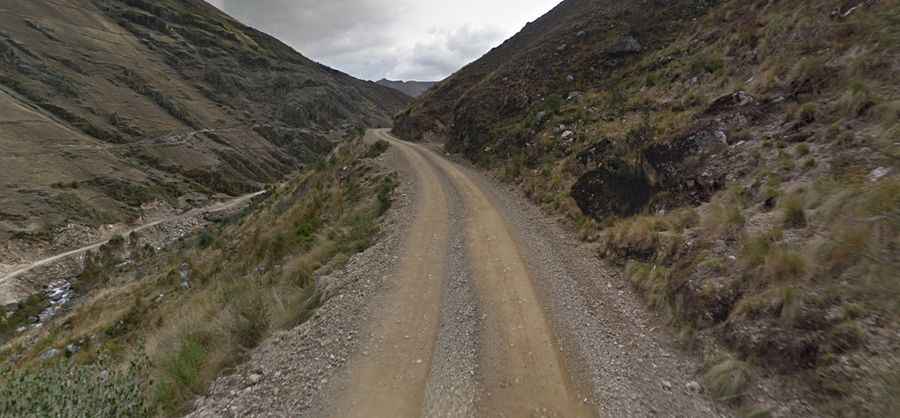
| Road facts: Carretera 106 (Pasco) | |
|---|---|
| Location | Pasco Province, Peru |
| Length | 100 km (62 miles) |
| Max Elevation | Above 4,300 m |
| Surface | Mostly Unpaved / Gravel |
How long is Carretera 106 in Pasco Province?
The road stretches for 100 km, starting from the town of Ninacaca. It runs east toward the Amazon basin, passing through Huachón. The route is a dead-end that finishes in a remote mountain area with no through-access. It sits entirely above 2,500 meters, providing access to high-altitude water bodies including Laguna Cochachuyo (4,324m) and Laguna Lulicocha (4,285m).
Is Carretera 106 in Pasco Province unpaved?
Most of the 100 km are unpaved, consisting of loose gravel and dirt. While some short sections near Huachón have been recently paved, the majority of the track is narrow and features hundreds of curves and tight hairpins. The road includes several unlit tunnels carved directly into the rock, where visibility is zero and the interior height is limited. A 4x4 vehicle is highly recommended to handle the steep ramps and the muddy sections created by mountain runoff.
What are the driving hazards on Carretera 106?
The most dangerous section is the drive along the river canyon, where the roadbed is extremely narrow and unprotected by guardrails. Despite the technical difficulty, the road is heavily used by large trucks carrying supplies to remote mining and agricultural outposts. Meeting a truck in the narrowest parts or inside the unlit tunnels requires long reversing maneuvers on the edge of the cliff.
Is Carretera 106 open year-round?
Heavy rainfall during the Andean winter (December to March) often causes landslides and washouts, blocking sections of the 100 km track. The unpaved surface turns into a thick mud bog, making traction impossible for non-4x4 vehicles. Fog is a constant hazard above 3,000 meters, hiding the sharp turns and the entrance to the tunnels. Drivers must be self-sufficient, as there are no services, fuel points, or mechanical help once you leave the main towns near the start of the route.