Cerro Las Campanas: Driving to the giant telescopes of the Atacama
Cerro Las Campanas is a high mountain peak at an elevation of 2,380m (7,810ft) above sea level, located in the Atacama Desert of northern Chile. The road leads directly to the Las Campanas Observatory astronomical facilities near the border of the Atacama and Coquimbo regions.
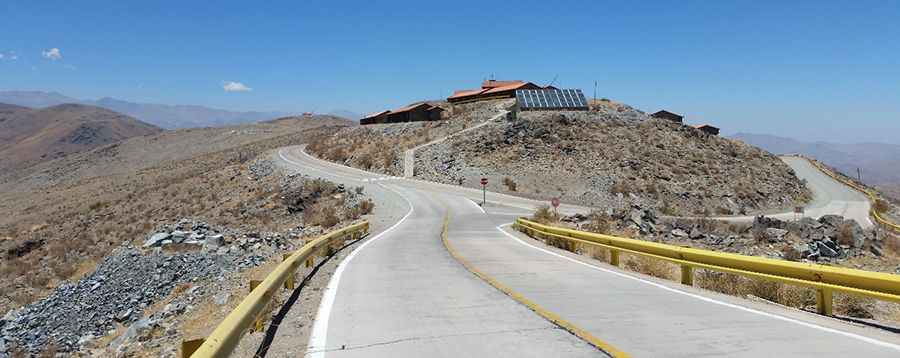
| Road facts: Cerro Las Campanas | |
|---|---|
| Location | Atacama Desert, Northern Chile |
| Elevation | 2,380 m (7,810 ft) |
| Length | 39.6 km (24.6 miles) |
| Average Gradient | 3.34% |
| Surface | Partially Paved / Graded Gravel |
Where is the road to Cerro Las Campanas located?
The route to the summit begins at a turn-off on Ruta 5 (Pan-American Highway), between the cities of Vallenar and La Serena. From the highway junction, the road spans 39.6 km (24.6 miles) into the interior mountain range. The track climbs an elevation gain of 1,325 meters before reaching the telescope domes at the top of the ridge.
Is the road to Cerro Las Campanas paved?
The road surface alternates sectors of asphalt and graded gravel. The gravel parts are packed to permit the transport of industrial telescope parts. The track is single-lane wide in the upper mountain sections, with earth shoulders and deep drop-offs that lack steel guardrails.
What is the weather like at Cerro Las Campanas?
At 2,380 meters, winter temperatures drop below freezing. High winds occur along the open ridges, and sudden mountain snowstorms cover the roadbed with ice sheets between June and August. The observatory operators close the access gate at the lower checkpoint when snow or ice impacts traction on the gravel switchbacks. Dense ocean mist, locally named camanchaca, reduces visibility to less than five meters along the route.
What are the driving hazards at Cerro Las Campanas?
The route is used by multi-axle freight vehicles and heavy supply trucks, requiring drivers to use the designated passing pockets on blind corners. The 3.34% average gradient features steep ramps on the final kilometers to the peak. Descending vehicles must use engine braking to regulate speed on the gravel layers and prevent tire sideslip on the curves.
Pic: Ida Leter