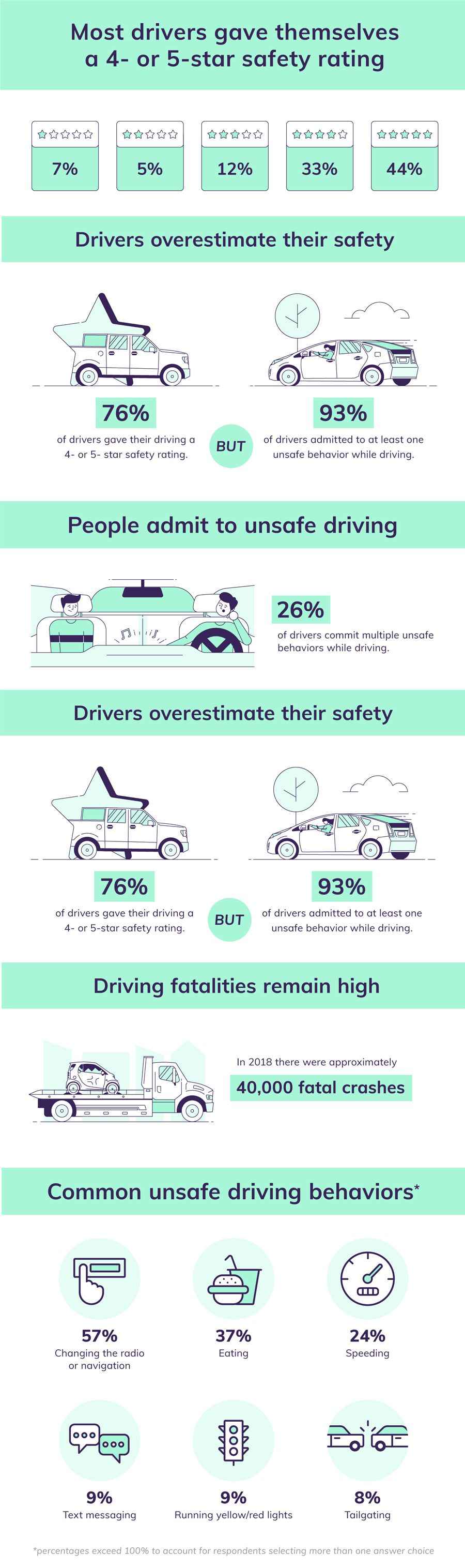
Why 76% of Americans Think They Are Safe Drivers (And Why They Are Wrong)
There is a profound disconnect between perceived driving competence and actual on-road behavior in the United States. While a vast majority of motorists self-identify as "safe" or "expert" drivers, forensic traffic data and behavioral surveys paint a more alarming picture. This phenomenon, often referred to as the "Illusion of Superiority," creates a dangerous environment where overconfidence leads to a systematic disregard for basic safety protocols, turning high-speed arterials into zones of high-consequence risk.
| Behavioral Discrepancy: The Safety Gap | |
|---|---|
| Perceived Safety | 76% of drivers rate themselves as "Safe" or "Very Safe" |
| Admitted Risk | 93% engage in at least one unsafe driving behavior |
| Multi-Factor Risk | 25% (1 in 4) admit to multiple dangerous behaviors |
| Psychological Driver | The "Illusion of Superiority" (Cognitive Bias) |
The Anatomy of the Safety Paradox
The statistical data reveals a critical failure in driver self-assessment. While three-fourths of respondents believe they operate within a "safe" margin, the reality of the American road system is defined by frequent violations. An overwhelming 93% of drivers admit to engaging in activities that directly correlate with fatal accidents—such as distracted driving, speeding, or failing to maintain following distances—yet they fail to categorize these actions as a compromise to their "safe driver" status.
High-Frequency Violations and Normalization of Risk
One in four drivers (25%) acknowledges a pattern of multiple unsafe behaviors during a single transit. The danger lies in the "normalization of deviance," where a driver repeatedly survives a risky maneuver (like texting while driving or aggressive merging) and mistakenly interprets this survival as a proof of skill rather than luck. This reinforces the bias, leading to a progressive escalation of risk on technically demanding routes.
Conclusion: Bridging the Perception Gap
True road safety requires an objective analysis of one’s own driving telemetry, not a subjective feeling of competence. On the world's most dangerous roads, overconfidence is often the primary cause of mechanical and human failure. To lower the national accident rate, motorists must first recognize that their self-perception is likely skewed. Real safety is a disciplined, iterative process of risk mitigation, not a static personality trait.