Driving the unpaved Snake Creek Road to Johnson's Mill in Nevada
Johnson's Mill is a historic mining site at an elevation of 3,074 meters (10,085 ft) above sea level located in White Pine County, in the US state of Nevada. It is one of the highest roads of Nevada.
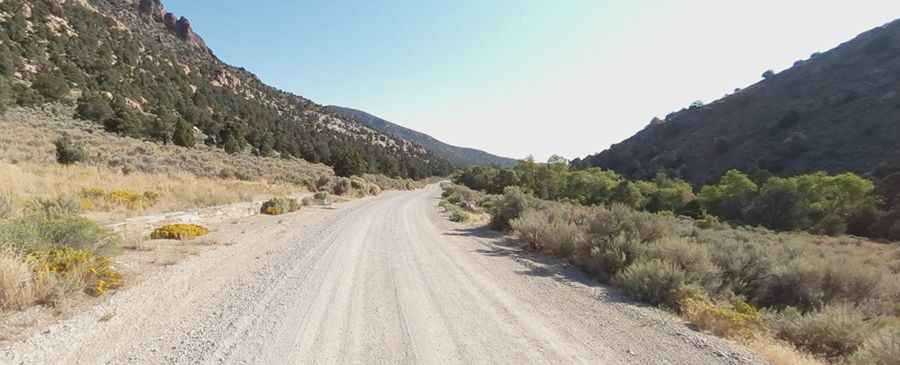
| Road facts: Snake Creek Road to Johnson's Mill | |
|---|---|
| Location | White Pine County, Nevada (USA) |
| Elevation | 3,074 m (10,085 ft) |
| Length | 29 km (18 miles) |
| Surface | Unpaved (Graded gravel, dirt, and rough rocks) |
| Vehicle Required | High-clearance 4x4 |
Where is Johnson's Mill?
The mill is located in the eastern part of Nevada, near the Utah border, within the Great Basin National Park.
Is the road to Johnson's Mill unpaved?
The road to the mill is called Snake Creek Road. The initial section consists of a graded gravel track, but the surface degrades rapidly once entering the National Park boundary. The final kilometers narrow down to a single-lane dirt track with embedded boulders, deep erosion ruts, and steep gradients. A 4x4 vehicle with high-clearance is required.
How long is Snake Creek Road to Johnson's Mill?
The 29-kilometer (18 miles) drive begins near Garrison, Utah, and climbs into the high ridges of the Snake Range.
Is Snake Creek Road open during the winter months?
Heavy snow blocks the entire mountain route from late October until late June. The road receives no winter maintenance. The reliable driving window is restricted to July, August, and September.
Pic: Paul Plath