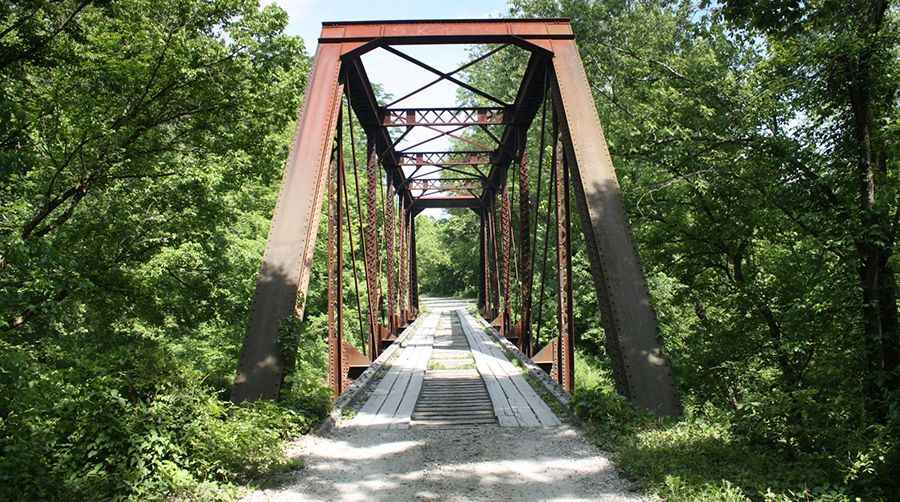
Crossing the historic Little Sandy River Railroad Bridge in Kentucky
The Little Sandy River Railroad Bridge is a historic single-lane pin-connected Pratt through truss bridge spanning 49.1 meters (161.1 ft) across the Little Sandy River in Carter County, in the US state of Kentucky. Originally built in 1873 for train traffic, the former railroad span carries a rural dirt access road near Hitchins and Leon. It's one of the most spectacular bridges in the world.
| Road facts: Little Sandy River Railroad Bridge | |
|---|---|
| Location | Carter County (Hitchins / Leon), Kentucky (USA) |
| Length | 49.1 m (161.1 ft) |
| Structure Type | Pin-connected Pratt through truss (Former railway conversion) |
| Original Build Date | 1873 (Chesapeake and Ohio Railway) |
| Original Rail Line | C&O Lexington Subdivision |
| Surface | Timber plank track over railroad ties, unpaved gravel approaches |
| Access Status | Open to single-lane local vehicular traffic |
Where is the Little Sandy River Railroad Bridge located?
The bridge sits in eastern Kentucky's Carter County, crossing the Little Sandy River along a former rail corridor between Fultz, Leon, and Hitchins. It is one of three historic rail spans surviving along this abandoned section of track.
What type of structure carries the road over the river?
Erected in 1873 for the Chesapeake and Ohio Railway (Lexington Subdivision), the 161.1-foot single-span Pratt through truss features a high steel portal frame and iron tension rods. Following the line's railway abandonment, workers converted the railbed for motor vehicles by placing longitudinal timber running boards directly over the ties.
Can you drive across the Little Sandy River Railroad Bridge?
Yes. The structure remains open to light local vehicle traffic operating as a narrow single-lane crossing. Drivers must check for oncoming cars on the opposite bank before entering the steel frame.
What are the driving conditions on the Little Sandy River Railroad Bridge?
Unpaved dirt and gravel tracks lead directly onto the bridge, where drivers must keep their tires aligned with two parallel rows of longitudinal wooden planks. Moisture makes the timber decking slick, while the narrow overhead steel portal leaves minimal side clearance for light trucks or SUVs.
Pic&more info: http://bridgehunter.com