How long is the Chesapeake Bay Bridge-Tunnel in Virginia?
The Chesapeake Bay Bridge-Tunnel (officially named the Lucius J. Kellam Jr. Bridge-Tunnel) is a 37-kilometer (23-mile) fixed link spanning the mouth of the Chesapeake Bay in Virginia, USA. Connecting Virginia Beach and the Hampton Roads metropolitan area with Northampton County on the Delmarva Peninsula, the multi-lane structure functions as a combined trestle bridge and underwater tunnel system. It’s one of the most spectacular bridges in the world.
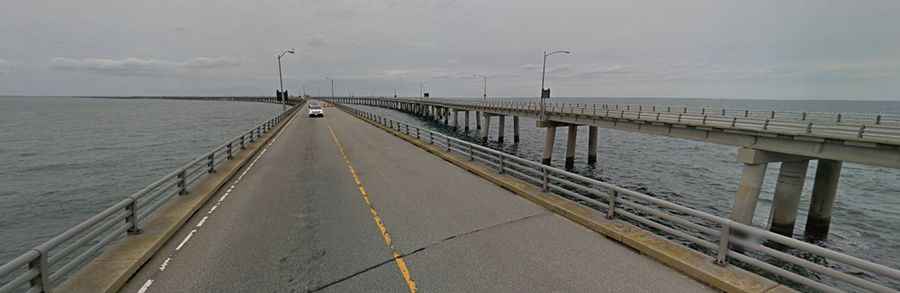
| Road facts: Chesapeake Bay Bridge-Tunnel | |
|---|---|
| Location | Chesapeake Bay, Virginia (USA) |
| Official Name | Lucius J. Kellam Jr. Bridge-Tunnel |
| Route Designation | US Route 13 |
| Total Length | 37.0 km (23.0 miles) shore-to-shore |
| Structure Type | Concrete trestles, causeways, four artificial islands, and two 1.6-km underwater tunnels |
| Opening Date | April 15, 1964 |
| Toll Facility | Yes (E-ZPass / Cash) |
| Key Hazards | Severe crosswinds, fog, heavy naval and commercial shipping collisions |
Where is the Chesapeake Bay Bridge-Tunnel located?
The facility crosses the open waters at the entrance of the Chesapeake Bay, carrying US Route 13. It anchors at Virginia Beach on the southern end and the rural Eastern Shore (Delmarva Peninsula) on the northern end, spanning 17 miles of open water between shores.
How was the Chesapeake Bay Bridge-Tunnel constructed?
Construction began in 1960 and involved over 2,000 workers utilizing precast concrete trestles, heavy steel beams, and granite armor stone. Seven workers died during the construction process due to severe Atlantic storms and heavy machinery accidents. The crossing opened to commercial and passenger traffic on April 15, 1964.
Is the Chesapeake Bay Bridge-Tunnel a toll road?
Yes. The crossing operates as a toll facility managed by the Chesapeake Bay Bridge and Tunnel District. Tolls are collected in both directions via E-ZPass or cash, with rates varying based on the time of travel and vehicle class. Over 130 million vehicles have crossed the facility since its opening.
Why does the bridge go underwater into tunnels?
The link incorporates two 1.6-kilometer (1-mile) immersed tube tunnels beneath the Thimble Shoal and Chesapeake shipping channels. This underground design was required to maintain unobstructed sea lanes for major commercial shipping traffic and the US Navy's Atlantic Fleet based at Naval Station Norfolk.
What hazards exist on the Chesapeake Bay Bridge-Tunnel?
The primary hazards are gale-force ocean crosswinds, dense coastal fog, and heavy storm surges that force temporary wind restrictions or total closures. Historically, the structure has suffered three major ship collisions, where barges or cargo vessels struck support trestles during severe weather, causing temporary closures for structural repairs.