How long is the Quarter Circle Bridge in Montana?
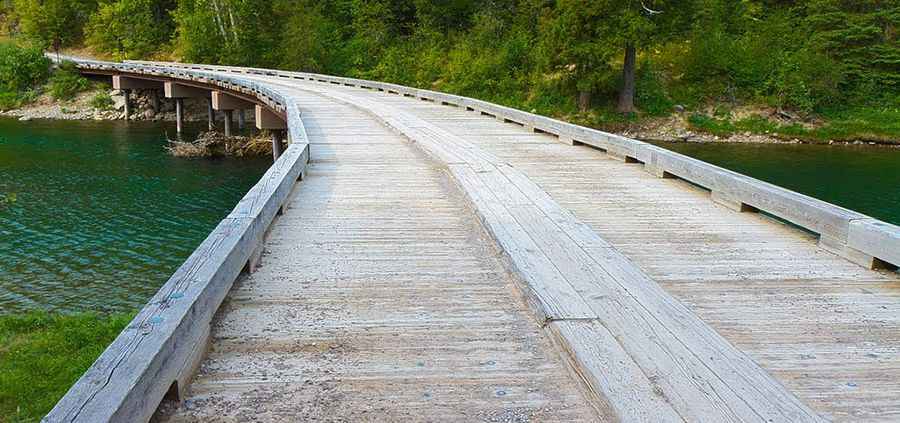
The Quarter Circle Bridge is a historic curved timber pile trestle bridge spanning 59.1 meters (194 ft) in Glacier National Park, Montana, USA. Carrying the unpaved Quarter Circle Bridge Road over the confluence where McDonald Creek merges with the Middle Fork Flathead River, it's one of the most spectacular bridges in the world.
| Road facts: Quarter Circle Bridge | |
|---|---|
| Location | Glacier National Park, Montana (USA) |
| Route Designation | Quarter Circle Bridge Road |
| Length | 59.1 m (194 ft) |
| Structure Type | Curved wooden pile trestle bridge with wooden guardrails |
| Surface | Wooden plank deck running parallel to traffic |
| Access Status | Unplowed in winter; subject to seasonal flooding closures |
| Key Hazards | Slippery timber deck, river flood surges, low wooden side curbs |
Where is the Quarter Circle Bridge located?
The bridge sits in the southwestern sector of Glacier National Park near West Glacier. It spans the water directly where McDonald Creek flows into the Middle Fork of the Flathead River, carrying Quarter Circle Bridge Road through the dense river pine forest.
What type of bridge is the Quarter Circle Bridge?
The 194-foot structure is a curved wooden pile trestle bridge resting on timber pilings driven into the riverbed. The deck consists of thick timber planks laid lengthwise along the arc, flanked by low wooden side beams instead of standard steel barriers.
Is the Quarter Circle Bridge open year-round?
No. Quarter Circle Bridge Road is an unplowed dirt access route that closes during winter due to heavy snow accumulation. Additionally, rapid snowmelt during spring runoff causes the Middle Fork Flathead River to overflow, forcing temporary flood closures when high water levels submerge the timber pilings.
What are the driving conditions on the Quarter Circle Bridge?
The bridge is narrow and curved, requiring slow speeds to align tires with the timber deck planks. The wooden surface becomes extremely slick when wet or frosted, and the low wooden side curbs offer minimal protection against sliding off into the cold river currents below.
Pic: Richard Campbell