Driving in New York City: What Visitors Need to Know Before Getting Behind the Wheel
New York City is not dangerous the way a mountain pass or a desert track is dangerous. There are no sheer drops or washed-out bridges. But for drivers from out of town, it can be one of the most demanding places in North America to drive: dense traffic, aggressive merging, pedestrians everywhere, and a set of rules that differs from the rest of New York State.
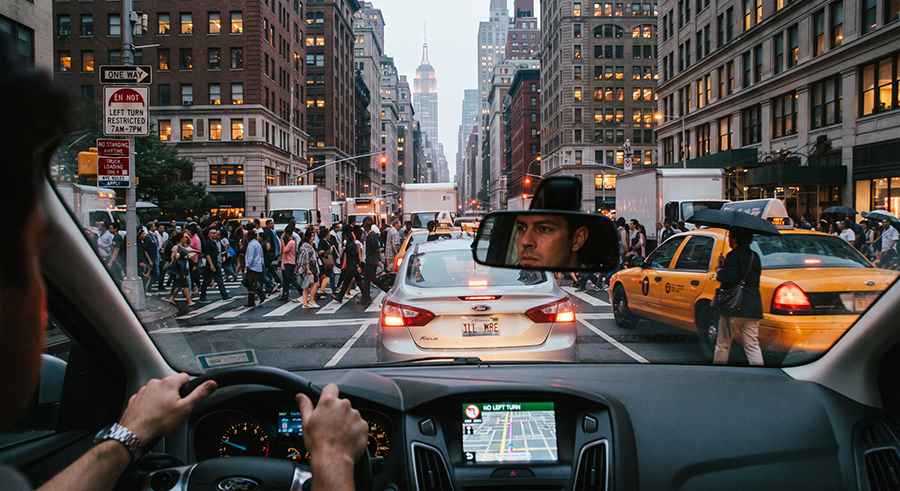
Old infrastructure adds to the challenge. Many of the city’s highways and parkways were built in the 1930s to 1950s for a fraction of today’s traffic. Here is what to know before you take a car into the five boroughs. Facts below were checked on Oct. 10, 2026.
Rules that catch out-of-town drivers
No right turn on red. In the rest of New York State, you can turn right on a red light after a full stop. In New York City, it is illegal unless a sign at the intersection specifically allows it, according to NYC 311. The only exceptions are certain intersections in Staten Island.
The speed limit is 25 mph. NYC DOT sets the city’s default speed limit at 25 mph unless another limit is posted. Many drivers from elsewhere assume 30 or more on wide avenues.
Speed cameras never sleep. NYC DOT operates speed cameras in 750 school speed zones, 24 hours a day, seven days a week, year-round. The cameras are triggered by speeds more than 10 mph over the limit, and the $50 violation goes to the vehicle’s registered owner.
The Congestion Relief Zone toll. Since January 5, 2025, vehicles entering Manhattan at or below 60th Street pay a toll, excluding the FDR Drive, the West Side Highway and the Hugh L. Carey Tunnel connections to West Street. According to the MTA, passenger vehicles with E-ZPass pay $9 during the peak period (5 a.m. to 9 p.m. on weekdays, 9 a.m. to 9 p.m. on weekends) and $2.25 overnight. Without E-ZPass, the Tolls by Mail rate is higher. The peak toll is set to rise to $12 in 2028.
The parkways: built for cars, not for anything taller
New York’s parkways are beautiful, winding roads, and they can be a trap. According to the New York State Department of Transportation, low stone bridges on the parkway system have posted clearances as low as 6 feet 11 inches. NYC DOT adds that the city has more than 300 roadway locations with less than 14 feet of vertical clearance.
That is why commercial vehicles, trucks and tractor-trailers are banned from the parkways. In the city, that includes the FDR Drive, the Belt Parkway, the Cross Island Parkway, the Henry Hudson Parkway north of 59th Street and the Hutchinson River Parkway, among others, according to NYC DOT’s parkway restrictions.
The biggest risk is for visitors who rent a moving truck or a tall van. Phone mapping apps built for cars can route a box truck straight onto a parkway, and a bridge strike can follow within minutes. In July 2026, the Governor’s office reminded drivers of rented box trucks to be especially aware of their vehicle’s height, and noted that New York now issues an 8-point violation for striking a bridge. If you are driving anything taller than a car, use a truck-specific route planner and obey every clearance sign.
The BQE: a highway past its design life
The Brooklyn-Queens Expressway’s triple cantilever, the stacked section below the Brooklyn Heights Promenade, carries more than 130,000 vehicles a day, including 13,000 trucks, according to NYC DOT figures reported by the Brooklyn Eagle in August 2026. That is more than double what it was designed for.
The city cut the cantilever to two lanes in each direction in 2021 and uses a weigh-in-motion system to ticket overweight trucks. It has now announced a 10-year, $4 billion rehabilitation plan. For drivers, the practical result is a narrow, busy stretch where lanes can drop for weekend work, so check traffic before you set out and leave room around trucks.
Practical tips for driving in the city
- Get E-ZPass, or check your rental company’s toll program. Bridges, tunnels and the Congestion Relief Zone are all tolled, and paying by mail costs more.
- Watch for pedestrians and cyclists at every turn. Pedestrians cross quickly, sometimes against the light. Turn slowly and check the crosswalk twice.
- Expect double-parked vehicles. Delivery trucks and cars stopped in the travel lane are part of daily life, so leave space ahead and be ready to merge.
- Plan your parking before you arrive. Street parking in Manhattan is scarce and heavily restricted. A reserved garage spot saves a lot of circling.
- Avoid the rush hours if you can. Crossings into Manhattan back up fast on weekday mornings and evenings.
Or leave the driving to someone else
For many visitors, the safest choice is not to drive in Manhattan at all. The subway reaches most of the city, and yellow cabs are everywhere. For airport transfers, business days or a night out, a professional car service such as artisanlimo.com puts a local chauffeur behind the wheel who knows the crossings, the parkway rules and the traffic patterns. The price is shown before you book, there is no surge pricing, and you can book by the hour if you have several stops.
The bottom line
New York City’s roads are not dangerous because of cliffs or ice. They are demanding because of density, old infrastructure and rules that surprise visitors. Learn the local rules, keep anything tall off the parkways and give yourself time. Or skip the stress and let a local do the driving.