CB Radio: The Lifeline of the Dalton Highway
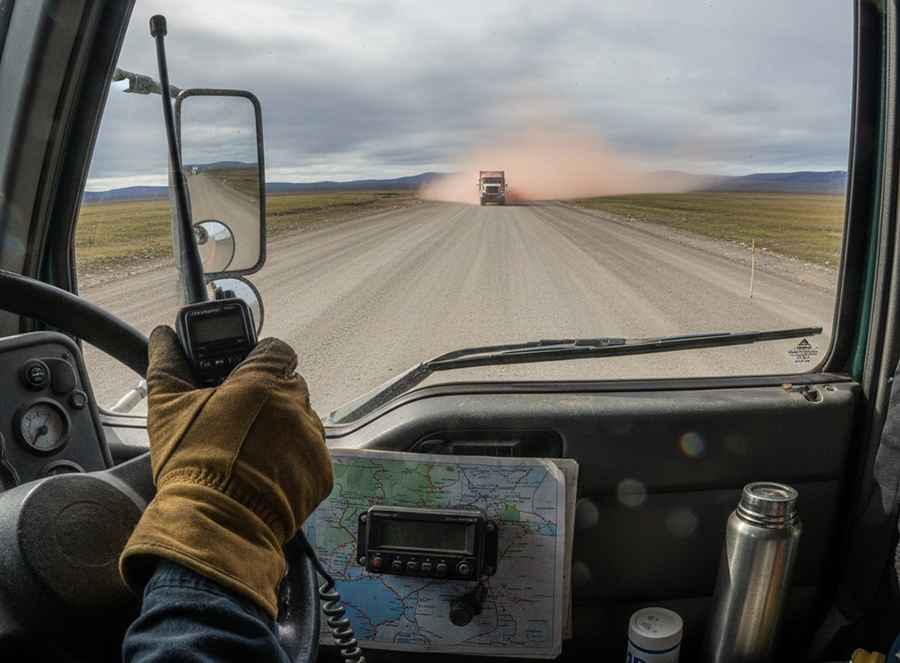
On Alaska’s remote Dalton Highway, standard safety tools like cell phones are useless. With hundreds of miles of zero signal and extreme arctic conditions, survival depends on a technology that predates the internet: the CB (Citizens Band) radio. For truck drivers and expeditionary travelers alike, the "CB" is more than a communication tool—it is a critical safety system used to navigate blind corners, heavy dust clouds, and life-threatening mechanical failures.
| Dalton Highway: Radio Protocols | |
|---|---|
| Standard Channel | Channel 19 (Primary for all traffic) |
| Range | 5 to 15 miles (Terrain dependent) |
| Primary Use | Position reporting and overtaking safety |
| Emergency Backup | Vital for SOS calls in "No Signal" zones |
Why the CB is Mandatory on the "Haul Road"
The Dalton Highway is an industrial corridor designed for heavy trucks supplying the Prudhoe Bay oil fields. The road is mostly gravel, creating massive plumes of dust in the summer and blinding "whiteout" conditions in the winter. In these scenarios, visual navigation is impossible. Drivers use the CB radio to "see" through the dust and snow by communicating with the vehicles they cannot see.
The Protocol: How Drivers Use the Radio
On the Dalton, radio etiquette is a matter of life and death. Most drivers stay tuned to **Channel 19**. Professional drivers follow a strict set of rules to keep the traffic flowing safely:
- Mile Marker Reporting: Drivers constantly announce their direction and location. For example, hearing *"Southbound at Mile 140"* allows an oncoming driver to prepare for a passing maneuver on a narrow segment of the road.
- Overtaking Safely: Passing a 50-ton truck on a gravel road is dangerous. A driver behind a truck will ask for a "clear" over the radio. The truck driver, who has a better view of the road ahead, will signal when it’s safe to pass.
- Warning of Hazards: Whether it’s a herd of caribou crossing the road, a fresh landslide, or a patch of "black ice," the CB radio ensures that every driver in the vicinity is aware of the danger before they reach it.
Survival in Isolation
In a region where temperatures can drop to -40°F, a mechanical breakdown is an immediate emergency. If your vehicle fails on the Dalton, you cannot call for a tow truck with your smartphone. The CB radio allows you to reach out to the professional truck drivers—the "kings of the road"—who monitor the channels and are often the first to offer assistance or relay a distress message to the nearest outpost at Coldfoot or Deadhorse.
Practical Tips for Travelers
If you are planning to drive the Dalton, investing in a high-quality CB radio and a long-range antenna is as important as carrying spare tires and extra fuel.
- Learn the Lingo: You don't need to be a pro, but understand basic terms like "copy" (I understand) and "breaker" (requesting to speak on the channel).
- Listen More Than You Talk: Keep the channel clear for essential position reporting. Only speak when you need to coordinate a pass or report a hazard.
- Check Your Hardware: The vibration from the gravel road can shake antennas loose. Ensure your mount is secure before leaving Fairbanks.
Conclusion: The Voice of the Road
The Dalton Highway is a place where modern convenience vanishes and self-reliance takes over. The CB radio is the invisible thread that connects every traveler on this lonely stretch of arctic road. By adopting this "old school" technology, you become part of a safety network that has kept drivers alive for decades in one of the most unforgiving environments on Earth.