How long is the Jug Bridge in Maryland?
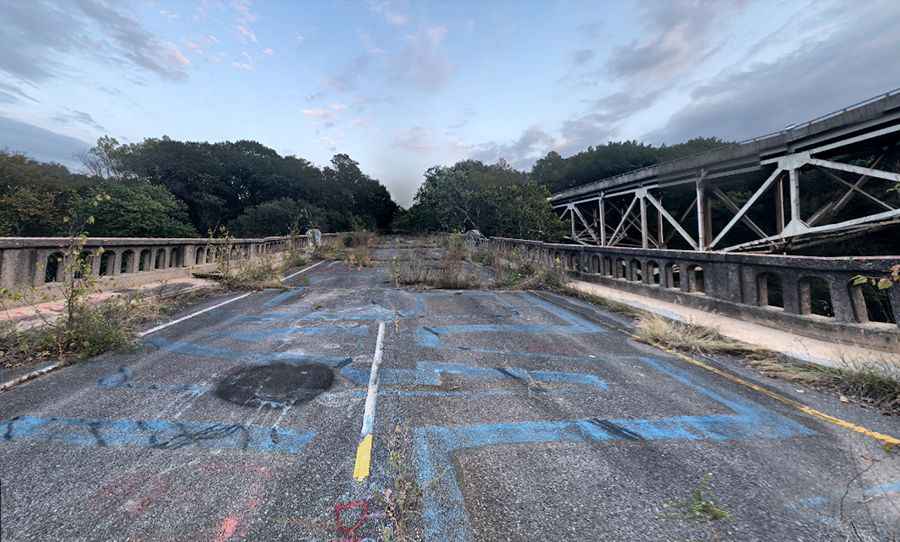
The original Jug Bridge was a historic 129.5-meter (425 ft) stone arch bridge spanning the Monocacy River in Frederick County, in the US state of Maryland. Built in 1808 by local stonemason Leonard Harbaugh as part of the National Road, the historic route carries Old National Pike (MD 144) east of Frederick. Today, the abandoned 1944 concrete replacement bridge stands directly beside a modern span carrying traffic, ranking among the most spectacular bridges in the world.
| Road facts: Jug Bridge Ruins and Monocacy River Crossing | |
|---|---|
| Location | Frederick County (Frederick), Maryland (USA) |
| Route Designation | Old National Pike (MD 144) / Historic National Road |
| Original Length | 129.5 m (425 ft) across four stone arches |
| Height Above River | 21.3 m (70 ft) above the Monocacy River |
| Build Dates | 1808 (Original stone arch) / 1944 (Concrete girder bridge) |
| Collapse Date | March 3, 1942 (East arch collapsed into the river) |
| Access Status | 1944 bridge is abandoned/blocked; active traffic uses modern adjacent MD 144 bridge |
Where are the Jug Bridge ruins located?
The bridge site crosses the Monocacy River two miles east of downtown Frederick, along the historic alignment of the National Road (MD 144). The abandoned highway segment and its concrete span sit directly alongside the active modern river bridge.
What is the history of the original Jug Bridge?
Erected in 1808 for $55,000 by mason Leonard Harbaugh, the original bridge featured four 65-foot stone arches extending 425 feet across the gorge. It gained its name from a large stone monument shaped like a demijohn jug placed on its eastern end. On March 3, 1942, a key arch collapsed under traffic. State engineers built a temporary wooden structure, then demolished the remaining stone arches in 1944 to construct a new concrete girder bridge. The stone jug monument was saved and moved to a park near East Patrick Street in 1965.
Can you drive across the 1944 Jug Bridge?
No. When a modern highway bridge was built to carry current MD 144 traffic, the 1944 concrete bridge was permanently bypassed and abandoned. Fences block motor vehicles from entering the old road deck, leaving the asphalt surface overgrown with weeds and covered in street art.
What are the conditions at the abandoned Jug Bridge site?
The abandoned 1944 deck still stands high over the river bed right next to the active traffic span. The old asphalt roadway is heavily deteriorated, with crumbling concrete balustrades, encroaching vegetation, and dead-end approaches that cut off abruptly at both riverbanks.
Pic: Michael Preston