Avrasya Tuneli, built underneath the seabed of Bosphorus
The Eurasia Tunnel (Avrasya Tüneli) is a major double-deck undersea highway tunnel located in Istanbul, Turkey. The toll route runs beneath the seabed of the Bosphorus Strait, establishing a direct vehicular link between Kazlıçeşme on the European side and Göztepe on the Asian side of the city.
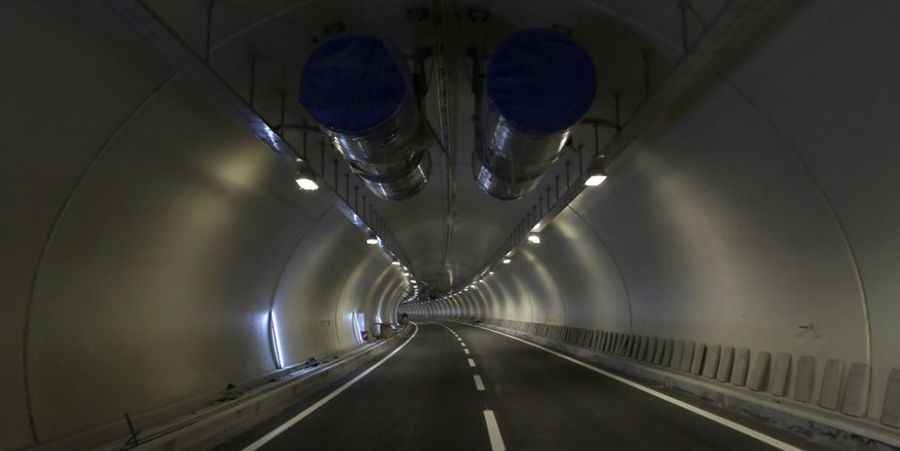
| Road facts: Eurasia Tunnel (Avrasya Tüneli) | |
|---|---|
| Location | Istanbul, Bosphorus Strait, Turkey |
| Total Route Length | 14.5 km (9.0 miles) |
| Undersea Segment Length | 5.4 km (3.3 miles) |
| Maximum Depth | 106.4 meters (349 ft) below sea level |
| Vehicle Height Limit | 2.8 meters (9.1 ft) |
| Year Opened | 2016 |
When was the Eurasia Tunnel built?
Tunnel excavations commenced on April 19, 2014, using a specialized tunnel boring machine to drill through the seabed rock layers. The structural link officially opened to vehicle traffic on December 20, 2016. The engineering design incorporates flexible seismic joints to absorb ground displacements, allowing the structure to withstand an earthquake measuring up to magnitude 9.0 on the Richter scale.
What is the road profile inside the Eurasia Tunnel?
The total project length spans 14.5 km (9.0 miles), with a core 5.4-kilometer segment drilled directly under the seabed of the Bosphorus Strait. The concrete tube is divided into two separate decks, stacking two lanes of traffic per level. The upper deck carries vehicles traveling from Europe to Asia, while the lower deck tracks from Asia to Europe. The asphalt road features steep approach and exit gradients as it drops toward its lowest point at 106.4 meters below sea level.
What are the vehicle restrictions in the Eurasia Tunnel?
The tunnel design limits access strictly to passenger cars, vans, and light commercial vehicles. The maximum height clearance is 2.8 meters (9.1 ft), which completely bars heavy cargo trucks, buses, and vehicles carrying hazardous materials from entering the toll plazas. Motorcycles are permitted to use the lanes under specific regulatory conditions, while non-motorized transport and pedestrians are prohibited.
What are the driving hazards inside the undersea tunnel?
The maximum legal speed limit is 70 km/h (43 mph), enforced by continuous speed-camera grids along both decks. The main driving hazard is the sudden transition from daylight into the illuminated tunnel tube, combined with the continuous downward incline that alters vehicle braking distances. An average of 120,000 vehicles use the route daily, creating high traffic density during peak hours where minor rear-end collisions cause immediate delays inside the narrow double-deck lanes.
Pic: https://www.businessistanbul.com/avrasya-tuneli-trafige-acildi/?lang=en