Driving to Coll de Pradell: The 2,135m unpaved pass in Serra d'Ensija
Located in the heart of the Serra d'Ensija, in the Berguedà region of Barcelona, the ascent to Coll de Pradell is a high-altitude journey reaching 2,135m (7,004ft) above sea level. This pass, situated at coordinates 42.19404, 1.64757, should not be confused with the paved pass of the same name located further east. This is a raw, high-mountain environment where the asphalt disappears to give way to a technical track that demands respect from both the driver and the vehicle's mechanics.
| Road facts: Coll de Pradell (Ensija) | |
|---|---|
| Location | Vallcebre / Saldes, Barcelona (Spain) |
| Elevation | 2,135 m (7,004 ft) |
| Length | ~10.0 km |
| Surface | Unpaved / Grass and loose rock |
| Status | Seasonal (Snow from Nov to May) |
Where exactly is the Coll de Pradell located?
This pass is positioned in the Pre-Pyrenees mountain range, specifically within the Serra d'Ensija-els Rasos de Peguera park. Unlike the paved pass nearby, this route stays on the high ridges and provides access to the alpine meadows. It is a world of limestone and high pastures where the track is often barely visible against the landscape. Navigating this area requires clear visibility, as the clouds can settle on the 2,135m crest in minutes, erasing all landmarks and making it easy to lose the main road among the cattle paths.
What is the road surface of Coll de Pradell like?
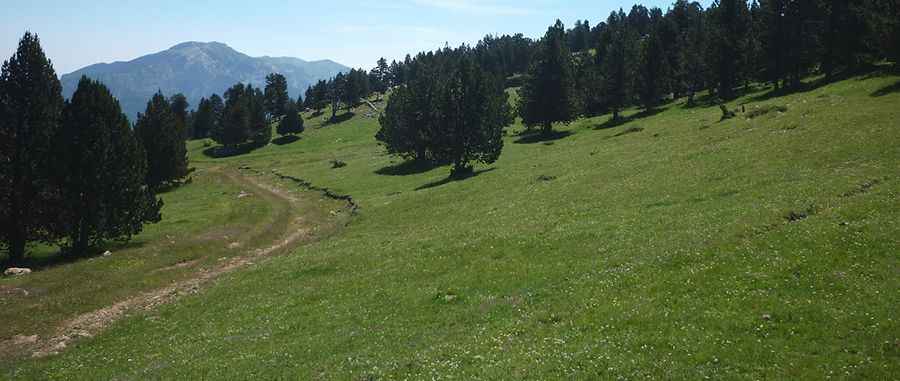
The road to the summit of Coll de Pradell is totally unpaved. It consists of a mix of loose limestone rocks and significant grassy sections. These grassy stretches are the main hazard; even with a 4x4, if the ground is damp from morning dew or recent rain, the tires will lose traction instantly, making the steeper ramps a challenge of momentum and tire pressure. The track is narrow and features deep ruts carved by mountain runoff and local cattle movement. You need a vehicle with high ground clearance to avoid hitting the bedrock that often protrudes in the middle of the path.
How technical is the 10km ascent to Coll de Pradell?
The 10km climb to Coll de Pradell is a sustained effort for the vehicle. The incline is not uniform, featuring sudden spikes in gradient where the loose surface makes the tires spin. Because it is a high-altitude track, you must manage your engine temperature and be prepared for the power loss caused by the elevation. The route is only recommended from late spring to early fall. During the rest of the year, snow blocks the path, and the melting process turns the grassy sections into a bog of mud that is impassable even for heavy-duty off-roaders.
What are the main hazards of Coll de Pradell?
The primary hazards of Coll de Pradell are the lack of grip on the grass and the extreme exposure to the weather. There are no safety barriers, and the track often runs along the edge of steep slopes where a single locked wheel during braking could be fatal. You must check your brakes thoroughly before starting the 10km descent, as the sustained steepness will put a massive strain on the system. Engine braking is mandatory here. Also, be aware of the local livestock; the cows often occupy the track in the grassy areas, and there is very little room to maneuver around them or turn the vehicle around if the path is blocked.
Pic: Isidre blanc