Driving the 4x4 track to Braña de Murias Chongas: 1,650m in Somiedo
The ascent to Braña de Murias Chongas is a high-mountain unpaved track located in the heart of the Somiedo Natural Park, within the Asturias region of northern Spain. Officially designated as part of the PR AS-15.1 route, this mountain path links the village of Valle de Lago with the high summer pastures at an elevation of 1,650 meters (5,413 ft) above sea level.
| Road facts: Braña de Murias Chongas | |
|---|---|
| Location | Valle de Lago, Asturias (Spain) |
| Elevation | 1,650 m (5,413 ft) |
| Road Name | PR AS-15.1 (Camino de Murias Chongas) |
| Length | 6.2 km (3.8 miles) |
| Surface | Unpaved (Deep ruts and bedrock) |
How is the track from Valle de Lago to Murias Chongas?
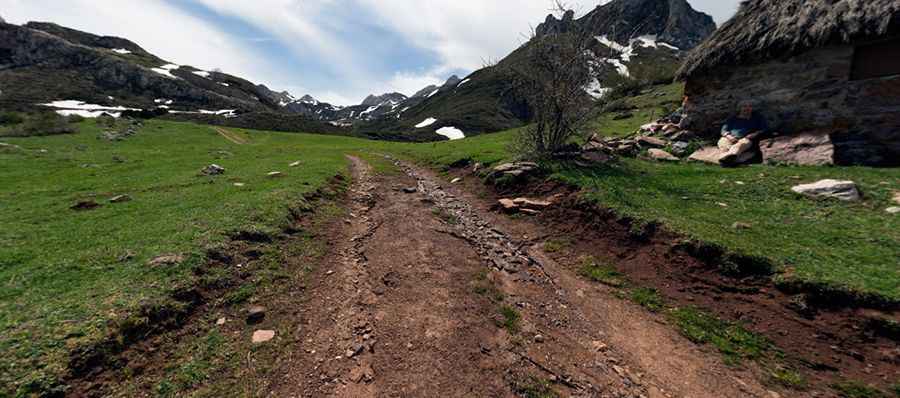
The unpaved climb begins directly at the end of the asphalt road in the village of Valle de Lago. The route covers a distance of 6.2 kilometers, tackling a vertical elevation gain of 410 meters with an average gradient of 6.61%. The track surface undergoes severe water erosion, exposing large horizontal slabs of limestone bedrock and deep center ruts that demand high ground clearance to prevent vehicle undercarriage damage.
What are the main terrain hazards on the PR AS-15.1 road?
The track consists of a narrow dirt floor mixed with loose limestone stones and damp clay. Mountain runoff continuously alters the surface, creating new erosion channels and deep potholes overnight. The path lacks lateral steel guardrails or runoff margins along the steep mountain drops. High-altitude fog layers frequently reduce visibility across the Cantabrian track, which lacks intermediate turnouts for vehicles to pass each other.
Is the track to Braña de Murias Chongas open year-round?
The 6.2-kilometer mountain ascent is impassable during winter and spring due to heavy snow accumulation and deep mud bogs. Rain turns the clay surface into a slick layer where tires lose braking traction on the steep inclines. The path runs through a protected environmental area flanked by hidden karst sinkholes and peat bogs, completely devoid of roadside services, mobile phone coverage, or emergency facilities.
Pic: Tim Cooper