Tossal d'Engrilló: The steep 4x4 track through the Parc Natural dels Ports
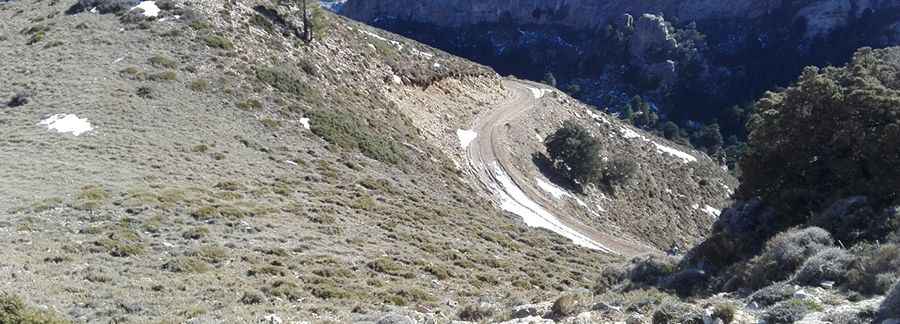
Tossal d'Engrilló is a mountain peak at an elevation of 1,072 meters (3,517 ft) above sea level, located in the Terra Alta region of Tarragona, Catalonia. The road to the summit, situated within the rugged Parc Natural dels Ports, is a technical unpaved track that scales the limestone massifs of southern Catalonia. The physical reality of driving this route involves managing a raw dirt and gravel surface where the vertical gain of 715 meters over a short distance tests the vehicle's low-end torque and cooling capacity under sustained load.
| Road facts: Tossal d'Engrilló (Els Ports) | |
|---|---|
| Location | Tarragona, Catalonia (Spain) |
| Elevation | 1,072m (3,517ft) |
| Length | 9.8 km (6.0 miles) from TV-3541 |
| Average Gradient | 7.29% |
How challenging is the 9.8km climb to Tossal d'Engrilló?
The journey starting from the TV-3541 road is a continuous mechanical effort through dense woodland and open rocky ridges. To gain 715 meters in just 9.8 kilometers, the track maintains a steady average gradient of 7.29%, but several ramps on the limestone steps are significantly steeper. The logistics of the climb are defined by the loose nature of the "pedregam" (loose stones), where a 4x4 vehicle is mandatory to maintain traction and avoid spinning out. As you climb, the track becomes narrower and the ruts deeper, forcing the driver to pick a precise line to avoid damaging the oil pan or the exhaust system on the uneven ground.
What are the hazards on the unpaved track to the summit?
The primary hazard on the Tossal d'Engrilló road is the violent wind typical of the Terra Alta highlands. On high-wind days, the exposure on the upper ridges is total; the force can be strong enough to destabilize a vehicle with high sail area, making the ascent impossible. The physical reality of the surface is that it is prone to washouts after the heavy storms common in the Ports massif. There are no safety barriers, and the descent requires extreme caution; relying only on the brakes for nearly 10 kilometers of dirt drop will glaze the pads, requiring the constant use of engine braking and low gears to manage the car's weight.
What is the logistical reality of the Els Ports mountain refuge?
Reaching the refuge at 1,072 meters requires a vehicle in top mechanical condition. While the track is used by local forestry units, there are zero services and very few spots to turn around if the road is blocked by a fallen tree or a landslide. The logistics of the route are dictated by the isolation; any mechanical failure—like a punctured radiator or a broken suspension link—leaves you stranded in a high-vibration environment where assistance will take hours to arrive. The dust and vibration on the long woodland stretches will test every seal and bolt on your vehicle, demanding a slow, methodical pace to protect the drivetrain.
What mechanical prep is needed for the 1,072m Terra Alta climb?
Before heading up from the TV-3541, verify that your tires are All-Terrain with reinforced sidewalls to handle the sharp limestone debris of the Ports. Check your cooling system and air filter; the fine dust of the mountain tracks will clog the intake during the low-speed, high-rev climb. Ensure your battery and lighting are operational, as fog can roll in from the Ebro Delta in minutes, reducing visibility to zero. Carry a full-size spare and a high-lift jack, as changing a tire on the uneven dirt of the Tossal ramps is a difficult maneuver. In southern Catalonia, your car's mechanical integrity is the only buffer against the harsh reality of the limestone peaks.
Pic: CAROLINA CORTIELLA FANLO