How to drive the paved road through Puerta del Infierno in Cuenca?
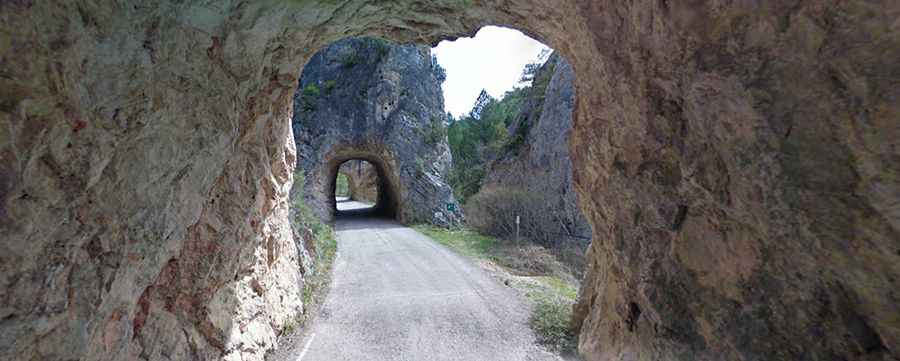
Puerta del Infierno is a narrow canyon passage on the CUV-9031 road, located in the Province of Cuenca, Castile-La Mancha, Spain. Built in 1925, the paved route runs along the Escabas River canyon between Cañamares and Fuertescusa, passing through natural rock arches and unlit hand-carved tunnels. It’s one of the most scenic canyon roads of Spain.
| Road facts: Puerta del Infierno | |
|---|---|
| Location | Cañamares to Fuertescusa, Cuenca, Castile-La Mancha (Spain) |
| Road Name | CUV-9031 |
| Length | 6.0 km (3.72 miles) |
| Year Built | 1925 |
| Tunnels | 3 unlit rock tunnels |
| Surface | Paved asphalt (Narrow single-lane width) |
Where is the CUV-9031 road located?
The 6.0-kilometer CUV-9031 road connects the villages of Cañamares and Fuertescusa along the Escabas River gorge, in the northern sector of Cuenca province.
What are the driving conditions through Puerta del Infierno?
The 6.0-kilometer road is fully paved but single-lane width. Carved into limestone cliffs, the route follows the curves of the Escabas River through 3 short, unlit tunnels—locally known as Puerta del Infierno, Paso del Diablo, and Boca del Infierno. The narrow clearance through the rock arches restricts wide vehicles.
What hazards exist on the CUV-9031 through the canyon?
The narrow asphalt lacks central lane markings, requiring low speeds on blind corners cut into the rock face. High limestone walls expose the lane to falling rock debris, while strong canyon winds and sudden temperature drops are common along the river gorge.
Is the road through Puerta del Infierno open year-round?
Yes. The CUV-9031 remains open year-round with low traffic volumes. Cold winter snaps create localized black ice inside the unlit rock tunnels and shaded cliff corners along the riverbank.
Road suggested by: Markus Janssen