Driving the gravel road to Port de Fontalba in the Pyrenees
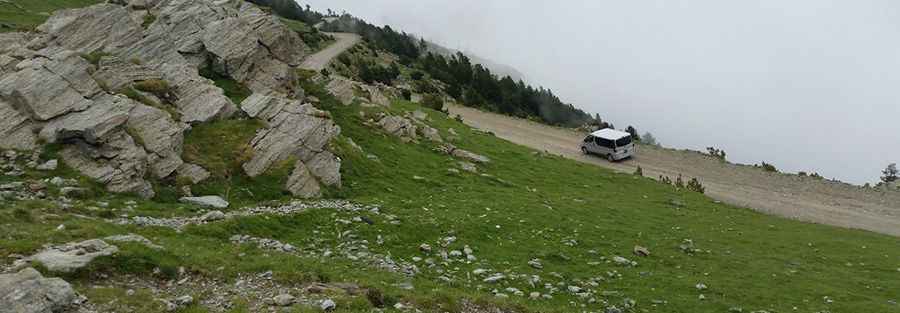
Port de Fontalba is a high mountain pass at an elevation of 2,071 meters (6,794 ft) above sea level, located in the Ripollès region of Catalonia, Spain. Situated in the eastern Pyrenees at the foot of Puigmal, the route leading to the summit is the Carretera de Fontalba. It is a long, unpaved single-lane mountain track packed with loose stone switchbacks, open dirt ramps, and severe vertical exposure with zero side protections.
| Road facts: Port de Fontalba | |
|---|---|
| Location | Queralbs, Ripollès, Girona (Catalonia, Spain) |
| Elevation | 2,071 m (6,794 ft) |
| Length | 11.3 km (7 miles) from Queralbs |
| Max Gradient | 9% |
| Surface | Unpaved gravel and packed dirt |
How rough is the 11.3-km climb on the Carretera de Fontalba?
The unpaved track begins right after leaving the stone houses of the village of Queralbs, at 1,219 meters high. From the valley floor, the dirt road climbs 852 vertical meters over an 11.3-kilometer run. The average gradient is 7.53%, but the hardest sections hit sustained ramps with a 9% incline on loose gravel. As the lane gains elevation and leaves the forest line behind, the track runs completely exposed along the edge of steep grass slopes. The surface consists of packed soil mixed with moving stones that cause two-wheel-drive cars to lose traction and spin out on the steeper pitches.
Why do the 15 hairpins of Port de Fontalba complicate passing?
The high-mountain track climbs the open ridge through 15 sharp hairpin turns. The apexes of these switchbacks are heavily weathered, constantly accumulating loose rocks, deep dust beds, and ruts cut by water runoff. The lane is narrow, barely wide enough for one standard vehicle. Meeting an oncoming car or a hiker's van forces one of the drivers to perform a reverse maneuver on loose dirt shoulders next to steep valley drops, backing up until finding a small natural clearing or a wider mountain turnouts to allow passing.
What damage can winter erosion and storms cause to cars on Fontalba?
The Carretera de Fontalba is a dead-end road that terminates at a wide dirt parking lot at 2,071 meters. Pyrenean winters and spring thaws open deep transverse drainage ruts and washouts across the path, leaving large rocks exposed in the middle of the driving lane. Standard passenger cars with low ground clearance face high risks of scraping their bumpers or puncturing the oil pan on these center ridges. Sudden summer mountain thunderstorms turn the dry gravel into a slick clay slurry in minutes. On the long 11.3-kilometer descent back to Queralbs, drivers must lock the vehicle in low gears to let engine braking hold the weight, preventing the foot brakes from overheating and failing on the 9% ramps.
Pic: Rossend C. M.