Driving the A-4301 to Alto de la Sagra: A bumpy climb in Granada
Located in the northern tip of the province of Granada, the ascent to Alto de la Sagra (popularly known as Puerto de la Losa) is a journey through one of the most rugged and isolated landscapes in Andalusia. Reaching an elevation of 1,764m (5,787ft) above sea level, the road—designated as the A-4301—is a technical nightmare for vehicles with poor suspension. It is a route where the limestone mass of La Sagra dominates a horizon of broken asphalt and high-altitude silence.
| Road facts: Alto de la Sagra (Puerto de la Losa) | |
|---|---|
| Location | Huéscar, Granada (Spain) |
| Elevation | 1,764 m (5,787 ft) |
| Road Name | A-4301 |
| Length | 17.5 km |
| Max Gradient | 13% |
Where is Alto de la Sagra?
The pass is tucked away in the autonomous community of Andalusia, sitting right near the border with Castile-La Mancha in the Huéscar region. You won't find a single road sign with the name of the pass at the summit; you only know you've reached Puerto de la Losa because the climb finally stops. This is a high-mountain desert environment where the road is the only sign of human presence for miles, winding through the foothills of the Sierra de Castril and Cazorla.
Are the views at Alto de la Sagra worth the drive?
If you care about your vehicle's alignment, you'll be too busy watching the ground to look at the scenery. However, the views of the massive La Sagra peak and the surrounding Sierras are some of the most raw in southern Spain. It’s a prime spot for spotting bearded vultures, but the real "spectacle" is the road itself—a narrow ribbon of decaying pavement that feels like it’s being reclaimed by the mountain. The visual reward is high, but the mechanical price is higher.
Is Alto de la Sagra paved?
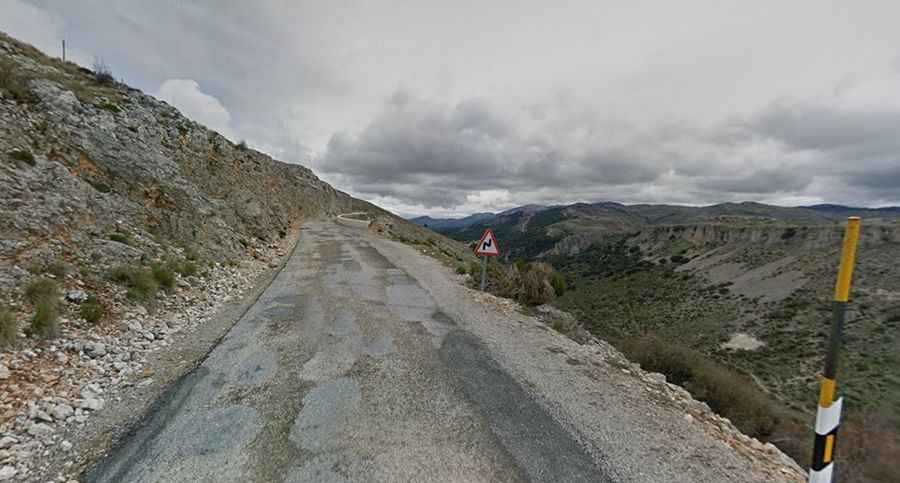
The A-4301 is technically a paved road, but the word "paved" is an overstatement. As seen on Street View, the asphalt is in terrible condition, covered in patches, deep potholes, and loose gravel. It is extremely narrow and features 13 hairpin turns that are often covered in debris. Driving here requires surgical precision; the road surface is so bumpy that it can easily bounce a vehicle off its line. The dangerous drops are unprotected, and the edges of the asphalt are crumbling, making the 10% ramps feel much more precarious than they appear on a map.
How long is Alto de la Sagra?
The entire transit spans 17.5 km, running north-south from the A-317 road toward the GR-9100. It is a sustained mission of concentration. Because of the "broken" state of the road, you cannot maintain a decent speed; every kilometer feels like three. The constant vibration from the bumps and the need to navigate around craters in the asphalt will test your patience and your vehicle's suspension mounts over the entire distance.
How remote is the drive to Alto de la Sagra?
This is one of the loneliest drives in Granada. You can drive for 20 kilometers without meeting another soul. This isolation is a major hazard; if you suffer a mechanical failure or a double puncture from the sharp-edged potholes, help is a long way off. There is virtually no cell service in the deeper valleys of the pass, so you must carry basic survival gear and a full-size spare tire. You are completely on your own out here.
Is Alto de la Sagra open in winter?
At 1,764m, snow and ice are guaranteed in the winter months. The road is often closed for short periods because maintenance is low priority on such a remote secondary route. The combination of 13% ramps and black ice on the shadowed hairpins makes it a deathtrap without winter tires. Even in early spring, the meltwater across the road can freeze overnight, turning the bumpy A-4301 into a skating rink.
How steep is Alto de la Sagra?
The climb is relentless. While the average gradient is 6%, that figure is deceptive because of the many "steps" in the terrain. You will hit several ramps with a maximum gradient of 13%. On this surface, a 13% incline is brutal; your tires will struggle to find grip on the loose gravel and patches, especially in the tight hairpins. You need to keep a steady throttle and use heavy engine braking on the way down to avoid overheating your pads on the bumpy, technical descent.