Antonio Parietti: The Engineer Behind Mallorca’s Most Dangerous Roads
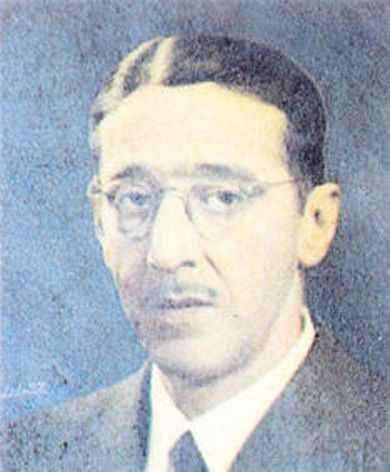
Antonio Parietti Coll (1899–1979) was a Spanish highway engineer responsible for designing the most technically complex mountain routes on the Mediterranean island of Mallorca. His career focused on adapting the steep topography of the Serra de Tramuntana range for motorized vehicles during the early and mid-20th century.
| Engineering Profile: Antonio Parietti | |
|---|---|
| Born / Died | Palma de Mallorca (1899 – 1979) |
| Primary Layouts | MA-2141 (Sa Calobra) / MA-2210 (Formentor) |
| Design Principle | No-tunnel geometry / 1:10 slope ratio adaptation |
| Key Feature | Nus de sa Corbata (270-degree hairpin bridge) |
What was Antonio Parietti’s road design strategy?
Parietti graduated from the Escuela de Ingenieros de Caminos in Madrid before returning to Mallorca to manage the Local Roads Plan. His design strategy rejected the use of expensive tunnels and heavy explosives, choosing instead to replicate the natural contours of the limestone cliffs. He calculated mountain slopes to maintain a steady 1:10 ratio (10% incline), ensuring that early low-horsepower cars could ascend the steep coastal walls of the island without stalling or burning out their clutches.
How did Antonio Parietti design the Sa Calobra road?
In 1932, Parietti engineered the MA-2141, commonly known as the Sa Calobra road. The 13-kilometer route drops 800 vertical meters down to the sea floor without a single tunnel segment. To resolve a sheer rock face cliff drop, Parietti designed the Nus de sa Corbata (the Tie Knot), a continuous 270-degree hairpin turn where the road loops directly over itself via a reinforced concrete bridge span. The layout also squeezes through the Pareis gorge, a narrow pass flanked by vertical rock walls where lane clearance drops to just over two meters wide.
What is the layout of the Cap de Formentor road?
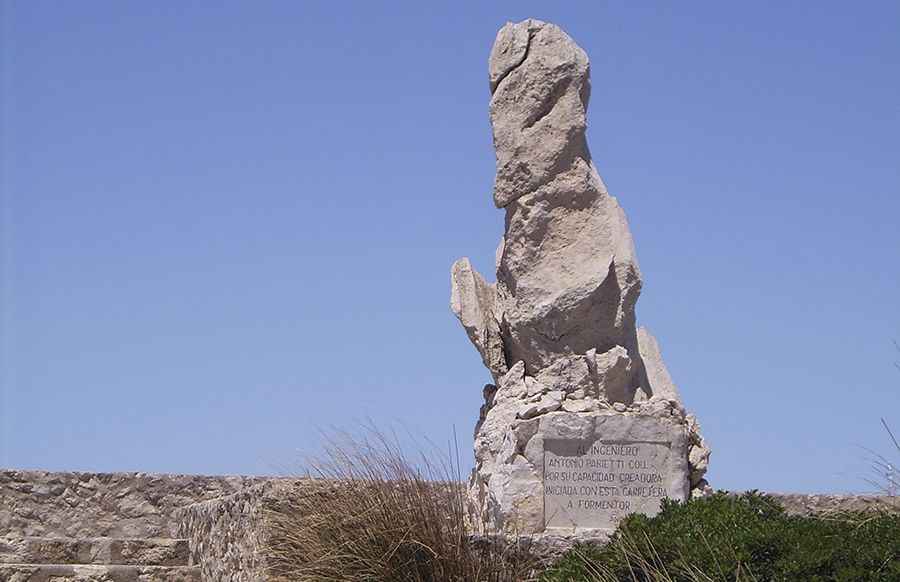
Engineered by Parietti in 1925, the MA-2210 leads through the northernmost peninsula to the Cap de Formentor lighthouse. The track runs along a narrow shelf cut directly into the vertical sea cliffs. Parietti placed the hairpin corners strategically at points where the wind force was minimized by the rock walls. At the first major cliff lookout point, the Mirador de Sa Creueta (El Colomer), a stone monument built in 1968 stands next to the asphalt shoulder, commemorating his technical achievements in the Serra de Tramuntana.
Pic: By Antonio De Lorenzo -> Kufoleto and Marina Ventayol [GFDL (http://www.gnu.org/copyleft/fdl.html), CC-BY-SA-3.0 (http://creativecommons.org/licenses/by-sa/3.0/) or CC BY 2.5 (https://creativecommons.org/licenses/by/2.5)], from Wikimedia Commons