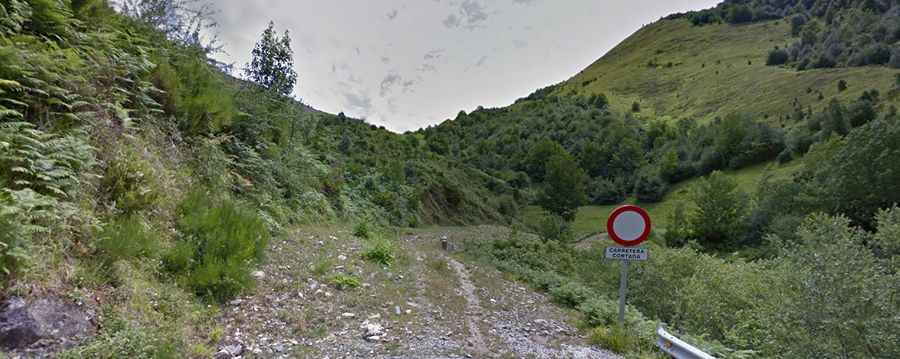
Driving the old and abandoned road to Puerto de Rañadoiro
Puerto de la Rañadoiro is a mountain pass at an elevation of 1,178 meters (3,864 ft) above sea level in the Asturias region of northern Spain. Once a vital link in the Sierra de Rañadoiro, this pass—also known as Puerto del Trayecto—has been relegated to a ghost road. Since the opening of a modern tunnel in 2010, the old path has been abandoned, leaving the asphalt to rot under the extreme weather of the Cantabrian Mountains. Driving here now isn't about transit; it’s a journey through a decaying route where the forest is reclaiming the roadbed and the physical hazards of neglect make it a technical challenge for anyone trying to explore what remains of the old Camino Real.
| Road facts: Puerto de Rañadoiro (Old Road) | |
|---|---|
| Location | Cangas del Narcea, Asturias, Spain |
| Elevation | 1,178m (3,864ft) |
| Length | 11.3 km (7.0 miles) |
| Status | Abandoned / Closed to through traffic |
Where is Puerto de Rañadoiro located?
The pass is situated in the southwestern part of Asturias, crossing the rugged Sierra de Rañadoiro. Historically, it was the main connection between Cangas del Narcea and Degaña, a route used since the Middle Ages when it was known as the ‘Camino Real del Trayecto’. Today, the geography remains just as harsh, but the isolation is total. As seen at the entrance of the old track, the road is officially closed to vehicles and is in a process of dismantling, meaning you are entering a high-isolation sector where no maintenance is performed and the elements have free rein over the terrain.
How difficult is the old road to Puerto de Rañadoiro?
The 11.3-kilometer ascent features an average gradient of 5.3%, but the difficulty now comes from the state of the surface. What used to be a paved road is now a "bumpy" and "rocky" mess. As seen in recent images, the vegetation has overgrown the edges, and the asphalt is covered in loose gravel and debris from small landslides. Navigating this section is technical; you have to manage deep ruts where the water runoff has carved through the old pavement. If you attempt to drive a vehicle here, you face the constant risk of catching your underbody on broken chunks of asphalt or getting high-centered on the piles of earth that have been placed to block the way.
Why was the Puerto de Rañadoiro road bypassed?
In 2010, the AS-15 was rerouted through the Rañadoiro tunnel to avoid the steep and dangerous switchbacks of the mountain pass. The tunnel is 1,924 meters long and is part of a nearly 4-kilometer bypass that completely replaces the 11.3 kilometers of the old, winding route. This modern infrastructure was necessary to eliminate the frequent winter closures caused by heavy snow and ice at 1,178 meters. The old road was often trapped by blizzards, making the logistics of keeping it open a nightmare for the regional authorities. With the tunnel in place, the high mountain road was left to the elements, effectively ending its life as a paved transit road.
What are the main hazards on the abandoned Rañadoiro pass?
The primary hazard is the total lack of maintenance. The "Carretera Cortada" signs at the base are there for a reason; the roadbed is failing, and there are no safety barriers left to prevent a slide down the steep slopes. In winter, the high altitude ensures that snow and ice remain on the track for months, but without snowplows, it becomes a frozen trap. During the summer, the main risks are the sharp rocks and the thick vegetation that hides the actual width of the road. If you find yourself on a narrow ledge and the ground gives way—which is common on abandoned mountain paths—there is zero cell signal and help is miles away in the new tunnel infrastructure.
What mechanical prep is needed for exploring abandoned roads?
If you are exploring the remnants of the Rañadoiro pass, your vehicle needs high ground clearance and reinforced tire sidewalls. The broken asphalt is sharper than natural stone and can slice through standard tires in an instant. Check your cooling system, as the slow-speed crawl over debris puts extra stress on the motor. On the descent, do not ride your brakes; the uneven surface requires constant speed adjustments, and you should use engine braking to stay in control. Carry a full-sized spare, a recovery kit, and plenty of water. A mechanical failure on a road that is "currently being dismantled" means you are in a survival scenario where no furgonetas or transit vehicles will ever pass by to help you.
Road suggested by: jorge manuel gómez sánchez