How to drive the military track to Colle Plane?
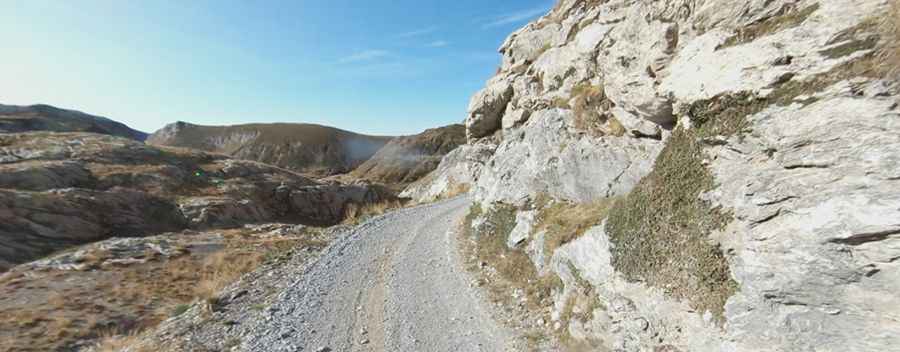
Colle Plane is a high-altitude mountain pass at an elevation of 2,222m (7,290ft) above sea level, situated on the international border between Italy (Piedmont) and France (Alpes-Maritimes). Located in the Ligurian Alps, the road to the summit is a critical segment of the historical Via Marenca and is technically integrated into the wider logistical network of the Via del Sale. This narrow, unpaved military track requires a high-clearance 4x4 vehicle due to extreme surface degradation and deep erosion gullies.
| Road facts: Colle Plane (Via Marenca) | |
|---|---|
| Location | Italy (Cuneo) - France (Alpes-Maritimes) |
| Elevation | 2,222 m (7,290 ft) |
| Surface | Unpaved (Loose Shale / Deep Ruts) |
| Technical Requirement | High-clearance 4x4 with low range |
| Notable Point | Capanna Morgantini (2,237m) |
What is the road condition on the Via Marenca towards Colle Plane?
The track leading to Colle Plane is a technical high-alpine "two-track" system. The surface is primarily composed of loose limestone shale and compressed marl, which is highly susceptible to hydraulic erosion. Technically, the sector features deep, parallel ruts that can exceed 30cm in depth, making it impossible for standard SUVs to transit without sustained underbody damage. Navigating the Via Marenca requires a "straddling" technique, placing tires on the high center ridge and the outer edge to maintain clearance. Logistically, the road is extremely narrow with vertical exposure and lacks safety barriers, requiring advanced defensive driving skills.
How to manage 4x4 logistics in the Ligurian Alps border sector?
Driving to Colle Plane involves navigating steep ramps with a high percentage of loose stone, which requires consistent torque delivery. Technically, a vehicle equipped with a locking rear differential is a significant asset to manage traction on the fractured rock sections. Logistically, the pass is often engulfed in "nebbia," a rapid-onset fog characteristic of the Ligurian Alps, which can reduce visibility to near-zero in minutes. If the track is saturated, the limestone dust transforms into a low-friction slurry. Drivers must monitor tire temperatures and pressures closely, as the sharp shale on the 2,222m pass is notorious for sidewall punctures.
What are the emergency protocols near Capanna Morgantini?
The Capanna Morgantini (2,237m), located just above Colle Plane, serves as the primary logistical landmark. This area is completely isolated; there are no fuel or mechanical services within a 3-hour driving radius. It is a mandatory safety protocol to verify weather windows for both the Cuneo (Italy) and Alpes-Maritimes (France) sectors before committing to the ascent. In the event of a mechanical failure on the Via Marenca, recovery logistics are extremely complex due to the track's narrowness, which precludes the use of standard flatbed tow trucks. Vehicles must be equipped for self-recovery with sand ladders and winching gear.
Is the Colle Plane pass open year-round?
Logistically, Colle Plane is a strictly seasonal route. The pass is typically blocked by deep snowdrifts from late October until late June. Technically, there is no snow removal service on this military track, and attempts to cross during the thaw period carry a high risk of getting bogged down in unstable soil. Before departure, drivers should check the operational status of the Via del Sale gates, as access to this sector is often regulated by a toll system and specific vehicle quotas. A thorough technical inspection of the vehicle's steering linkage and shock absorbers is required, as the sustained vibrations of the 2,222m transit often cause hardware fatigue.
Pic: Matteo Quaglia