How to drive the steep chairlift track to Platta de Grevon?
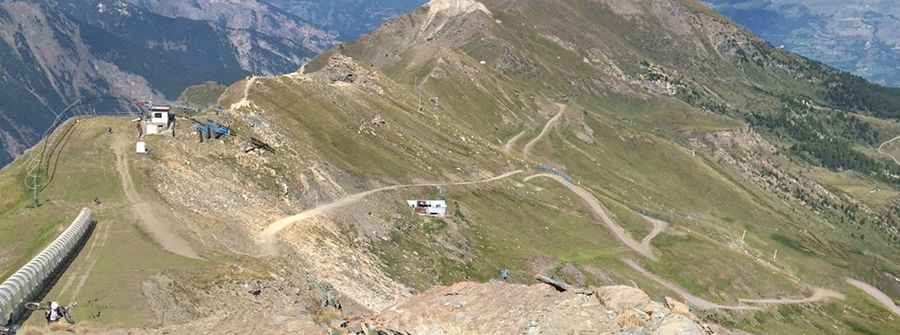
Platta de Grevon (also referred to as Piatta de Grevon in some Italian topographic maps) is a high mountain peak at an elevation of 2,715m (8,907ft) above sea level, located in the Valle d’Aosta region of northwestern Italy. Technically, it is one of the highest driveable points in the region, situated within the logistical perimeter of the Pila ski resort. The access route is a service road for chairlift maintenance that ranks among the highest roads in Italy.
| Road facts: Platta de Grevon | |
|---|---|
| Location | Aosta Valley, Italy |
| Elevation | 2,715 m (8,907 ft) |
| Length | 5.7 km (3.5 miles) |
| Max Gradient | 20% |
| Hairpin Turns | 21 |
| Technical Requirement | 4x4 with low range |
What are the technical driving challenges on the Platta de Grevon track?
The 5.7 km ascent from Pila to the summit of Platta de Grevon is a high-torque operation. Technically, the road features sustained gradients with sections reaching 20%. The surface is entirely unpaved, consisting of loose stones and fractured rock that becomes increasingly unstable in the upper sectors. Logistically, navigating the 21 hairpin turns requires a vehicle with a short wheelbase and a low-range transfer case to maintain traction without inducing excessive wheel spin, which can lead to track erosion and vehicle immobilization on the steep ramps.
How does the seasonal window affect the logistics of Platta de Grevon?
At 2,715 meters, the road is logistically impassable for the majority of the year due to snow cover and ski resort operations. Technically, the track is only driveable during a very narrow time-frame in late summer, typically around the **end of August**, after the snowfields have fully retreated and before the first autumn storms. Outside of this logistical window, the surface is either covered in deep snow or saturated with meltwater, making the 20% slopes technically unsafe for vehicle transit due to the high risk of sliding on the slick, unpaved base.
What are the hazards of driving on the Pila ski station service road?
The route to Platta de Grevon is a dedicated ski-station service road, meaning it lacks the engineering standards of public highways. Technically, the upper part of the road is extremely rocky and narrow, with no safety barriers. Logistically, drivers must account for heavy maintenance machinery that may be operational near the chairlift pylons. The high-altitude environment of the Valle d’Aosta means that weather conditions can shift in minutes, turning a technical climb into a hazardous descent where engine braking is mandatory to prevent brake fade on the 20% decline.
Vehicle maintenance for the 2,715m Platta de Grevon ascent
Before attempting the 5.7 km climb, a full technical verification of the vehicle’s cooling and braking systems is essential. The low-speed, high-stress nature of the 21-hairpin ascent provides minimal airflow to the radiator, increasing the risk of overheating. Tires must have high-grip tread patterns to manage the loose stone surface. Logistically, self-sufficiency is a requirement; there are no mechanical services available beyond the base at Pila. Carrying recovery equipment and verifying the integrity of all suspension components is a mandatory protocol for any vehicle venturing above 2,500m on these technical Alpine tracks.
Pic: Lorenzo Tabasso