Crossing the Laghi di Cedèc bridge: A 2.743m wooden platform in Stelvio
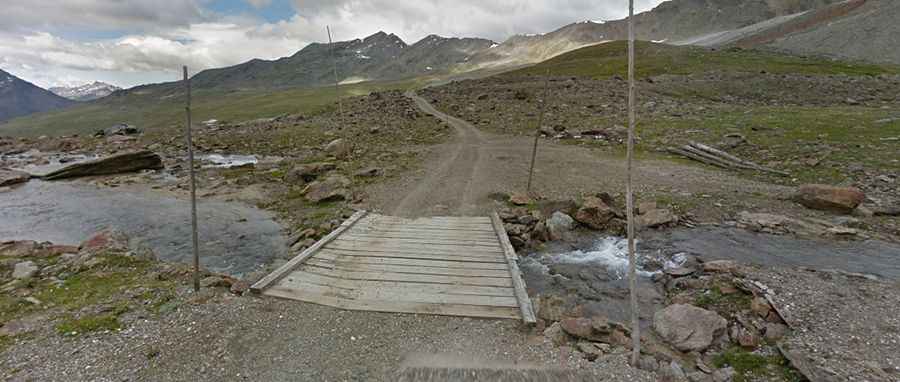
Located deep within the Parco Nazionale dello Stelvio, in the northern Italian province of Sondrio, the Laghi di Cedèc bridge is a high-altitude crossing that tests the limits of technical driving. Sitting at an elevation of 2,743m (8,999ft) above sea level, this precarious wooden structure serves as the only transit over a fast-flowing glacial river on the ascent toward the Cedèc lakes and the Pizzini refuge. It is a point where the raw power of the Alps meets a simple, unprotected platform, demanding absolute precision from any vehicle attempting the crossing.
| Road facts: Laghi di Cedèc Bridge | |
|---|---|
| Location | Sondrio, Lombardy (Italy) |
| Elevation | 2,743 m (8,999 ft) |
| Structure | Wooden planks / 2 meters long |
| Required | High-clearance 4x4 only |
| Access | Impassable October to June |
How hazardous is the wooden crossing to Laghi di Cedèc?
The transit over the Laghi di Cedèc bridge is one of the most technical moments on the road to Laghi di Cedèc. As seen in the rugged terrain of the Ortler-Cevedale group, the bridge is composed of heavy wooden planks that are constantly exposed to high humidity and freezing spray from the glacial runoff. At 2,743m, traction is the primary concern; wet wood offers nearly zero grip, and the short 2-meter span means your front and rear axles are in a critical state of balance as you cross. Any misalignment on the approach can cause the tires to slip toward the unprotected edges, as the bridge lacks any form of guardrails or safety barriers. A high-clearance vehicle is mandatory to clear the rocky steps on both the entry and exit points of the platform.
What are the mechanical risks of the Stelvio glacial river crossings?
Navigating the area around the Laghi di Cedèc bridge requires a vehicle in top mechanical condition. The primary hazard is the water level of the river; during the peak spring melt, the glacial flow can become aggressive enough to submerge the wooden planks or carry debris that compromises the structure's stability. The track is extremely narrow, making it one of the most spectacular bridges in the world due to its raw simplicity. The thin air at nearly 2,800 meters reduces engine torque significantly, making it difficult to maintain a steady crawl speed if you need to reverse or maneuver on the rocky banks. Sudden blizzards can hit the Stelvio park even in mid-summer, turning the wooden surface into a slick, icy trap in minutes.
What is the best driving strategy for the Pizzini refuge tracks?
Reaching this high-altitude crossing requires a strictly logistical approach to driving. You must maintain a slow, constant momentum when your tires hit the wooden planks to avoid spinning. On the rocky ascent beyond the bridge, use the lowest gears possible to manage the steep, uneven surface. Monitor your tire pressure and suspension constantly, as the transition from the hard wooden structure to the jagged stones of the riverbank can easily lead to a puncture or a snapped axle. In this remote sector of Sondrio, the road is a lesson in vehicle control—check the stability of the planks before crossing, pick your line through the rocks with surgical precision, and never underestimate the power of the glacial runoff beneath your wheels.