Driving the brutal service road to Rifugio Paion: The Alpe Cermis wall
Located at the highest point of the Alpe Cermis ski resort in Trentino, the ascent to Rifugio Paion is one of the most punishing climbs in the Val di Fiemme. Reaching an elevation of 2,223m (7,293ft) above sea level, this service road is a vertical monster designed for heavy machinery and chairlift maintenance. It is a journey where the rules of standard driving don't apply, and where the mechanical strain on your vehicle is constant from the first meter to the summit ridge.
| Road facts: Rifugio Paion (Alpe Cermis) | |
|---|---|
| Location | Tesero, Val di Fiemme (Italy) |
| Elevation | 2,223 m (7,293 ft) |
| Length | 8.6 km (from Tesero) |
| Average Gradient | 15.58% |
| Surface | Gravel with concrete strips |
How punishing is the 15.5% average gradient to Rifugio Paion?
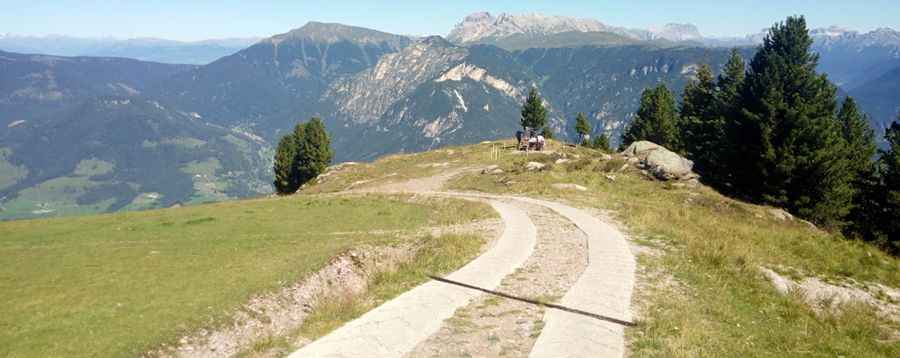
The 8.6 km climb from Tesero is a relentless battle against gravity, with a staggering 1,338-meter vertical gain. The average gradient stays at a brutal 15.58%, but several ramps exceed 20%. As seen on the high ridges of Alpe Cermis, the road is equipped with dual concrete strips to provide traction where standard gravel would simply disintegrate under a tire's torque. To reach the summit, a high-clearance 4x4 with a low-range gearbox is mandatory. Your engine will be operating at high RPM with very little forward speed, making overheating a primary risk. This is a "low-gear only" ascent where the torque demand never lets up until you reach the refuge's terrace.
What are the hazards of the Alpe Cermis chairlift road?
The road to Rifugio Paion is a functional service track, meaning it is narrow, steep, and completely unprotected. The primary hazard is the combination of extreme steepness and loose debris between the concrete tracks. If you lose momentum on a 20% ramp, restarting the vehicle is nearly impossible without sliding backwards. The weather in Val di Fiemme can change in minutes; from October to June, the road is buried under heavy snow, and even in summer, heavy rain can turn the gravel sections into a muddy mess. The 360° view of the Marmolada and the Brenta Group is spectacular, but the price is a drive where one mechanical failure or a missed gear change can lead to a dangerous situation on the exposed slopes.
What is the best mechanical strategy for the Paion descent?
Coming down from 2,223m is a high-stakes exercise for your braking system. A 15.5% descent over 8.6 km will melt standard brake pads before you reach the halfway point. You must engage heavy engine braking and pick your line carefully along the concrete strips to maintain control. Watch out for maintenance furgonetes and hikers, as space is extremely limited. The descent requires a "crawl" pace to avoid bouncing on the uneven surface, which can lead to a loss of steering. In this part of Trentino, the Alpe Cermis wall is a test of cooling systems and brake integrity—monitor your temperatures constantly and never underestimate the verticality of a ski resort service road.
Pic: Ale S.