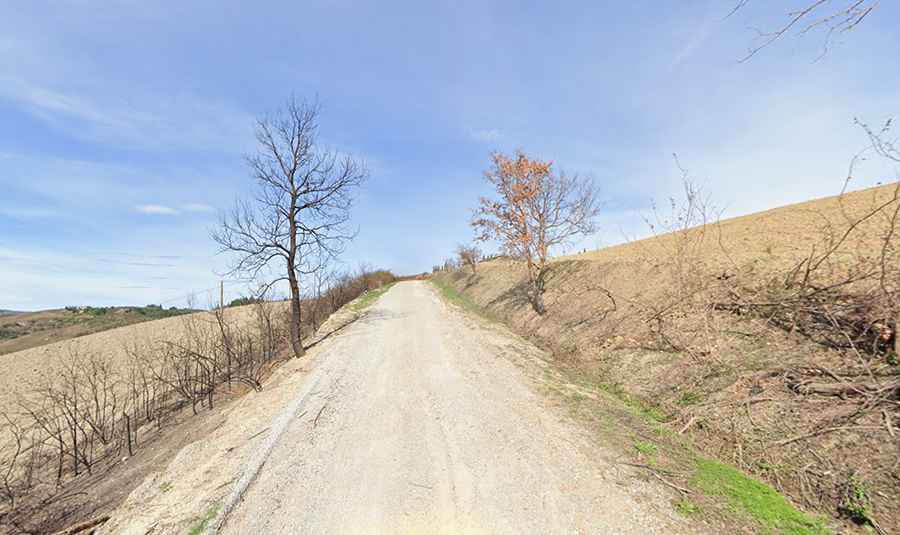
How to drive the steep gravel sector of Monte Sante Marie?
Monte Sante Marie is a notorious unpaved sector located in the Province of Siena, Tuscany, linking the towns of Asciano and Castelnuovo Berardenga. Known technically as a "sterrato" road, it is a key logistical segment of the Strade Bianche. The route is characterized by a surface of fine white clay and loose gravel, which presents significant traction challenges for motor vehicles, especially during the steep ascent and descent phases where the friction coefficient is extremely low.
| Road facts: Monte Sante Marie | |
|---|---|
| Location | Italy (Tuscany, Siena) |
| Distance | 11.5 km (Sector length) |
| Max Gradient | Up to 18% |
| Surface | Unpaved (White clay and gravel) |
| Technical Difficulty | Moderate (Low traction / Steep ramps) |
What are the driving hazards on the Monte Sante Marie sterrato?
The 11.5 km sector of Monte Sante Marie features a series of short, aggressive climbs with gradients reaching 18%. The primary technical hazard is the "sterrato" surface; the fine dust (volterra) acts as a lubricant between the tires and the hard base, leading to wheel spin on the climbs and locking under braking on the descents. For rear-wheel-drive vehicles, maintaining momentum is essential to avoid becoming stranded on the 18% ramps. The track is narrow and undulating, with several blind crests where the road drops away sharply, requiring precise positioning of the vehicle to avoid the softer, deeper gravel on the shoulders.
What are the vehicle logistics for the Tuscan gravel sectors?
Driving through the Siena gravel network requires a vehicle with effective Electronic Stability Control (ESC) or an All-Wheel Drive (AWD) system to manage the constant shifts in grip. Logistically, the fine white dust is highly abrasive and can quickly penetrate air filters and brake assemblies. After transiting Monte Sante Marie, it is a technical requirement to inspect the braking system, as the dust combined with heat can glaze the pads, reducing stopping power. Although high clearance is not strictly mandatory as in alpine tracks, a standard sedan may suffer underbody peppering from loose stones thrown up at speed.
How to manage traction and braking on clay surfaces?
Braking on the Monte Sante Marie descents requires a defensive approach. The 18% drops on a loose clay surface mean that conventional braking can easily trigger the ABS, significantly increasing stopping distances. It is a safety protocol to use engine braking to stabilize the vehicle's weight distribution. When wet, the white clay turns into a heavy, slippery mud that can clog tire treads, effectively turning All-Terrain tires into slicks. In these conditions, the technical difficulty increases exponentially, and the use of 4WD is highly recommended to maintain directional control on the off-camber curves.
Vehicle maintenance after driving the Strade Bianche routes
The 11.5 km of Monte Sante Marie puts specific stress on the vehicle's filtration and suspension components. Before attempting the route, ensure tire pressures are correctly adjusted; slightly lower pressures can increase the contact patch and improve traction on the gravel, but at the cost of increased puncture risk from sharp flints. Logistically, Asciano is the nearest point for mechanical check-ups. It is essential to wash the undercarriage and wheel arches after the transit to remove the corrosive clay-dust buildup, which can affect the longevity of rubber bushings and sensor wiring.