Bocca di Verdi: Driving the high-altitude D69 in Corsica
Bocca di Verdi is a mountain pass at an elevation of 1,289m (4,229ft) above sea level, located on the island of Corsica, France. The pass, also known as Col de Verde or Foci di Verdi, sits on the boundary between the departments of Corse-du-Sud and Haute-Corse. The road through the summit is a central segment of the D69, a high-altitude route that crosses the island’s interior through dense pine forests and granite ridges.
| Road facts: Bocca di Verdi (Col de Verde) | |
|---|---|
| Location | Boundary Corse-du-Sud / Haute-Corse |
| Elevation | 1,289 m (4,229 ft) |
| Length | 38.8 km (Ghisoni to Zicavo) |
| Route Name | Route des Trois Cols |
Where is Bocca di Verdi located?
The pass is situated in the heart of the Corsican mountains, linking the commune of Ghisoni in the north with Zicavo in the south. The road is part of the "Route des Trois Cols," a technical mountain axis that also includes Bocca di Sorba and Col de la Vaccia. This sector of the D69 is isolated, with no services or fuel stations between the two main villages, requiring a full tank before starting the transit.
Is the road to Bocca di Verdi paved?
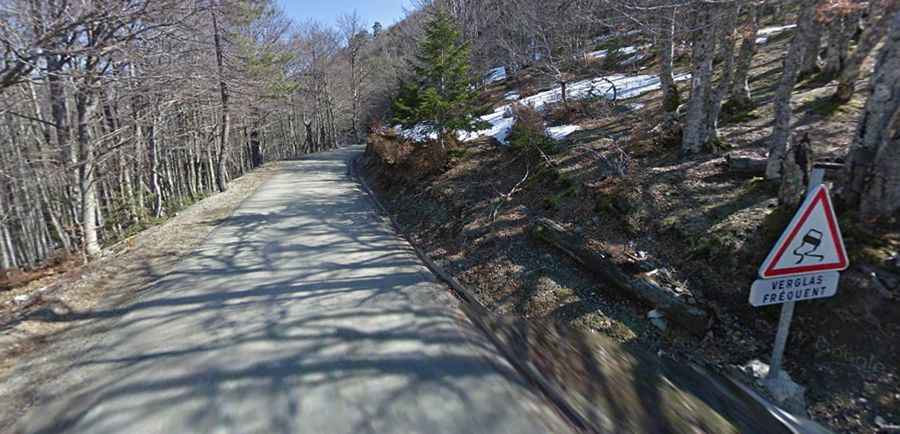
Yes, the entire 38.8 km stretch is paved, but the quality of the asphalt varies significantly. Due to the high elevation and heavy winter snowfall, the surface often features cracks, potholes, and frost heaves. The lane is narrow and lacks a center line in many sections, forcing drivers to slow down to a crawl when encountering oncoming timber trucks or local buses. The road is physically won from the forest and the rock, meaning the shoulder is often soft or non-existent.
How steep is the climb to Bocca di Verdi?
The climb from the north (Ghisoni) involves a sustained ascent through the forest of San Pietro di Verde. The gradient is steady but punishing for engines due to the constant sequence of curves that prevent maintaining a stable gear. On the descent toward Zicavo, the road follows a narrow ledge where engine braking is mandatory to prevent brake fade. At 1,289 meters, the air thins out, and cooling systems can struggle during the hot summer months if the vehicle is loaded.
What are the hazards of the D69 through Col de Verde?
The primary hazard is the presence of wild pigs and cows that frequently sleep on the warm asphalt or block the road behind blind corners. Rockfall is a constant threat, especially after the spring thaw or heavy rain. In winter, Bocca di Verdi is one of the first passes to be blocked by snow or black ice; despite being a departmental road, snow removal can be delayed. There are few safety barriers, and the drops into the valleys below are steep and unprotected by vegetation in the higher rocky sectors.
Why is Bocca di Verdi a technical drive?
Driving through Bocca di Verdi requires high focus because of the "closed" nature of the road. Dense trees limit visibility in the corners, and the track is often damp even in mid-summer. It is a logistical corridor for the mountain communities, meaning you must be prepared to share the narrow asphalt with wide agricultural machinery or local drivers who know the curves by heart. The constant mechanical work on the gearbox and steering makes it a high-vibration journey that tests the vehicle’s suspension and the driver’s endurance.