Route de Gros: The paved balcony road in the Queyras Mountains
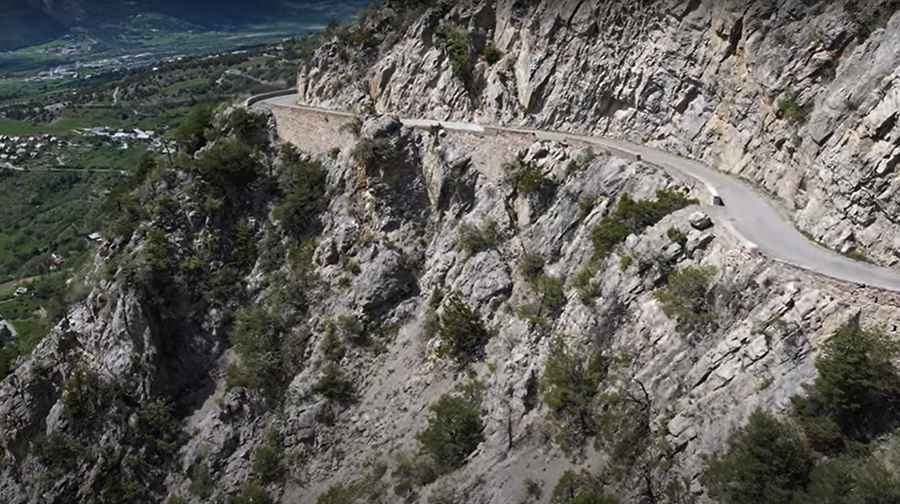
Located in the Hautes-Alpes department of southeastern France, Route de Gros is a spectacular yet challenging mountain road. Tucked away within the Parc Naturel Régional du Queyras, this route is celebrated as one of the most dramatic Balcony Roads in France, offering an intense driving experience high above the valley floor.
| Road facts: Route de Gros (D37L) | |
|---|---|
| Location | Hautes-Alpes, Provence-Alpes-Côte d'Azur |
| Max Elevation | 1,385 m (4,543 ft) |
| Length | 5.5 km (3.41 miles) |
| Road Number | D37L |
| Gradient | Steep (with hairpin turns) |
Where is Route de Gros?
The road, officially designated as the D37L, is located in the southeastern part of the country, north of the scenic Gorges du Guil. Starting from the village of Eygliers, the route climbs steadily into the heart of the Queyras region. This area is known for its high-altitude wilderness and historical fortifications, with the road acting as a literal balcony overlooking the junction of the Guil and Durance rivers.
Is Route de Gros Paved?
The road is fully paved with asphalt, but drivers should be prepared for varying surface qualities. While the majority of the track is solid, certain sections are in poor condition with loose gravel and rock debris scattered on the pavement. The road is built along vertical cliffs and is literally carved into the rock. In many parts, it is extremely narrow—scarcely wide enough for a single car—meaning that meeting oncoming traffic requires careful maneuvering and reversing skills. Fortunately, the road has almost no traffic, as it primarily serves the tiny hamlet at the top.
How Long is Route de Gros?
The ascent to the hamlet is 5.5 km (3.41 miles) long, starting from Eygliers. Over this relatively short distance, the road climbs aggressively through a series of steep ramps and tight hairpins, eventually reaching a maximum elevation of 1,385m (4,543ft) above sea level. The drive requires constant gear changes and steady braking on the way down, as the vertical exposure is constant and the road lacks substantial safety barriers in the most dramatic "balcony" sections.
Is Route de Gros Worth the Drive?
Absolutely. The road leads to Gros, a small, quiet hamlet featuring a tiny chapel and a hilltop hostel that feels frozen in time. The real draw, however, is the panoramic view. Along the climb, you can enjoy stunning 360-degree vistas of the Écrins massif, the town of Guillestre, and the UNESCO-listed fort of Mont-Dauphin—a massive stone fortress designed by Vauban during the reign of Louis XIV. The sight of the Guil River snaking through the gorges far below makes this one of the most photogenic drives in Provence.
Is Route de Gros open in winter?
No, the Route de Gros is typically impassable during the winter months due to heavy snow and ice. Because the D37L is a minor local road with very low priority, it is not regularly cleared of snow. Shaded cliffside sections can remain frozen and extremely slippery well into late spring. It is highly recommended to attempt this drive only between late May and October to ensure the pavement is clear and the vertical drops are visible.
What are the hazards of driving the D37L balcony road?
The primary hazard of Route de Gros is the extreme vertical exposure combined with the narrow roadbed. In many sections, there is no guardrail between your tires and a several-hundred-meter drop into the Guil valley. Rockfalls are also common, especially after rain or spring thaws. Drivers must be prepared to handle blind corners and should always honk before entering the narrowest "carved" sections to warn any potential oncoming vehicles. This is a technical drive that requires a cool head and a vehicle with reliable brakes.
Road suggested by: Jorge Manuel Gómez Sánchez
Pic&video: Dark Biker