Storebælt Bridge: Driving the 18km Great Belt Fixed Link in Denmark
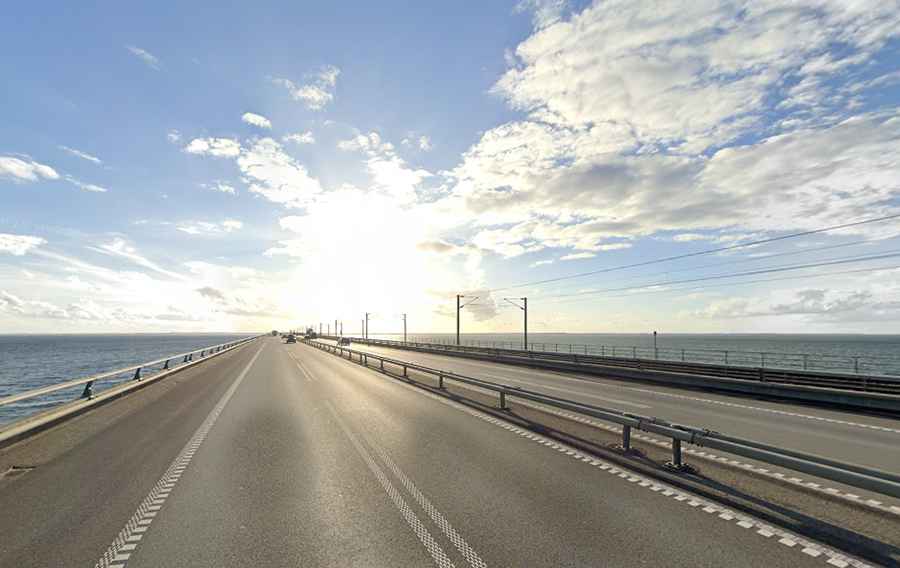
The Storebælt Bridge, or Great Belt Fixed Link, is a massive 18-kilometer structure connecting Nyborg on the island of Funen with Halsskov on Zealand, Denmark. The link consists of a suspension bridge (the East Bridge) and a box girder bridge (the West Bridge). The physical reality of driving this crossing involves managing extreme exposure to North Sea winds, where the road deck reaches 75 meters above sea level. This height, combined with the lack of surrounding terrain, makes the bridge one of the places on the European road network where the wind is most likely to push you out of your lane.
| Road facts: Storebælt Bridge | |
|---|---|
| Location | Nyborg to Halsskov, Denmark |
| Total Length | 18 km (11.1 miles) |
| Pylon Height | 254 meters (833 ft) |
| Max Gradient | 2.1% |
Will high winds flip your vehicle on the Storebælt Bridge?
Crosswinds are the primary danger on the Storebælt. When wind speeds exceed 10 m/s, furgonetes amunt i avall, trucks, and light trailers are officially advised not to cross. If gusts reach 15 m/s, high-sided vehicles are banned, and at 25 m/s, the bridge is completely closed to everyone. The physical reality of the 18km journey is that wind screens are only placed near the towers; for most of the transit, your car catches the wind and "fa vela", forcing you to grip the wheel hard to prevent the lateral pressure from drifting you across lanes. It's one of the most spectacular bridges in the world.
Can you handle the pylon turbulence on the East Bridge?
The East Bridge is a suspension structure with a free span of 1,624 meters. As you drive past the 254-meter pylons, the wind hits you differently. You get a sudden "clatellot" of air as you emerge from the shadow of the towers, which can displace a light car by a meter if you are distracted. Even with the wind screens, the pressure at 75 meters above the water is intense enough to move the car sideways in an instant. You need to keep both hands on the wheel to manage the abrupt steering corrections required when the wind stops being blocked by the massive concrete legs.
How do you manage the toll and breakdowns on the span?
The toll station is on the Halsskov side and never closes. Picking the wrong lane will cause a mess: green lanes are for tags (bizz), blue for cards, and yellow for cash. If your vehicle is wider than 3.3 meters, you must call the control room before arriving. If you stall or get a flat tire on the bridge, don't try to fix it yourself; CCTV cameras are watching, and a patrol car will be dispatched immediately to tow you off. Staying stopped at 75 meters high in these winds is a huge risk that can cause a massive pileup.
Which mechanical checks are needed for the Storebælt crossing?
Before heading onto the bridge, check your tire pressure; if they are soft, the wind will move the car’s body much more. Verify your trailer couplings and ensure all loads are double-secured, as the vibration from the steel expansion joints and the wind force can loosen the straps. Make sure your wipers are fresh, as salt spray from the sea can obscure the glass in seconds during a storm. On this exposed stretch of Denmark, if your steering rack isn't in top shape, you will struggle to keep the car straight against the heavy gusts.