Driving in Cyprus: the island roads, the left-hand rule and what British movers get wrong
Cyprus is one of the few places in Europe where a British driver arrives and finds the road immediately familiar. The island drives on the left, a legacy of its colonial period, which makes it one of only four countries in Europe to do so. For anyone bringing a right-hand-drive car from the UK, that single fact removes the compromise that Spain, France or Portugal would impose.
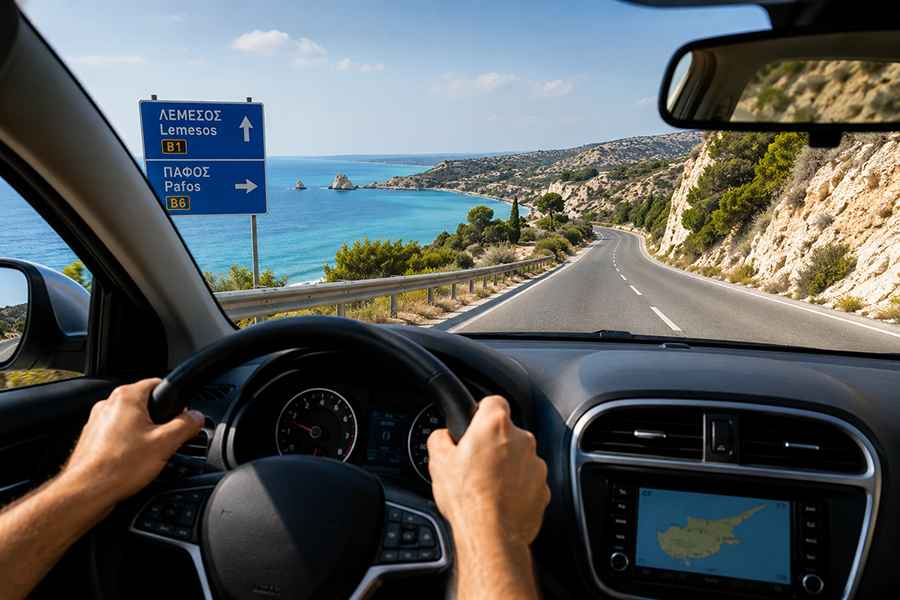
The geography is small and the driving is short
The practical daily radius for most residents is a town and its surroundings, with occasional cross-island runs between the four main centres. Nicosia sits inland as the administrative capital. Limassol is the commercial hub on the south coast. Larnaca has the main airport. Paphos is the quieter western end.
None of these is far from another by the standards of a mainland country, and that changes what a vehicle needs to be. Long-range touring capability matters less here than it does almost anywhere else in Europe.
A car is not optional
Public transport on the island is buses only. It is reasonable inside the larger towns and thin between them, which means there is no version of Cypriot life outside the city centres that works without a vehicle. Budget the car, the fuel or charging, and the insurance as a standing cost from day one rather than as something to sort out later.
The 2026 rule that touches drivers
Cyprus rewrote its personal tax rules with a package passed on 22 December 2025 and in force from 1 January 2026. Most of the attention went to the income bands, but the same reform introduced a set of personal deductions, and one of them is 1,000 euro for an energy upgrade or an electric vehicle.
Worth knowing, worth not overstating. It is a deduction from taxable income rather than a rebate, it depends on how the payment was made and on filing the return on time, and it is nothing like the purchase incentives seen in several mainland EU markets. Treat it as a footnote, not a reason.
The part that catches people out is not the driving
Since Brexit a British passport is a third-country passport in Cyprus. The yellow slip that EU citizens use to register is not available, and the residence route has to be chosen before anything is booked, because it determines whether a company has to exist first.
The realistic options are a visitor permit for people living on foreign income, a digital nomad permit for remote employees of non-Cyprus employers, a work permit through your own Cyprus company, permanent residency by investment, or the slow low-cost route for people living on secured foreign income. They differ enormously in cost and in what they allow, and several of them cannot be unwound once chosen.
That is the decision that actually shapes the first year, and it is worth reading before the car is on the ferry: what moving to Cyprus actually involves, route by route, with the money tests attached.
The summary for a driver
Cyprus is unusually friendly to a British car and a British licence-holder: left-hand traffic, short distances, familiar road conventions. The island rewards a small, efficient vehicle over a long-legged one. And the paperwork that decides whether you can stay has nothing to do with the car, which is precisely why it gets left until last.