Villacher Alpenstraße: Can your brakes handle the 116 curves and 10% gradient?
The Villacher Alpenstraße is a high-altitude toll road in Carinthia, Austria, climbing the Dobratsch massif. This 16.5 km route is a mechanical grind that forces a 1,200-meter vertical gain over a very short distance. With 116 curves and a sustained 10% gradient, it is a technical test for a vehicle's cooling and braking systems. It is one of the scenic alpine roads in Austria
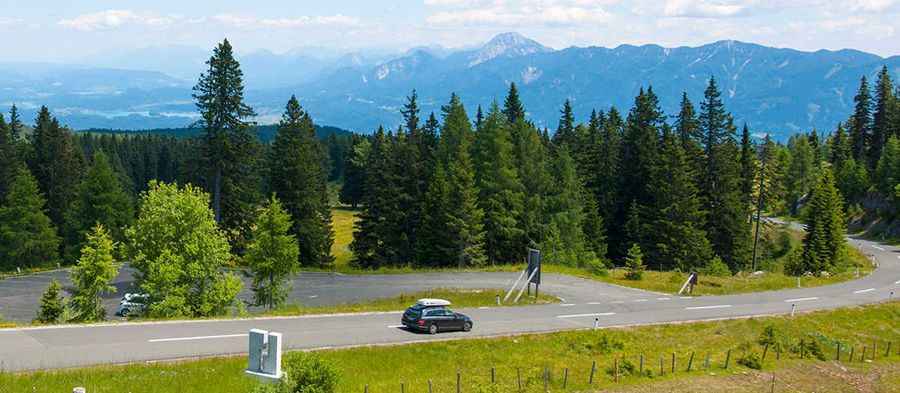
| Road facts: Villacher Alpenstraße | |
|---|---|
| Location | Carinthia, Austria |
| Elevation | 1,732 m (5,682 ft) |
| Length | 16.5 km (10.25 miles) |
| Max Gradient | 10% |
How demanding is the 1,200m climb on the Villacher Alpenstraße?
Starting at Villach-Möltschach, the road forces the engine to fight through 116 curves and 7 sharp hairpins to reach the Rosstratte parking lot at 1,732 meters. The 10% pitch is relentless, requiring high torque and putting the cooling system under heavy load. The curves are narrow, and managing the steering through 116 turns in just 16 kilometers requires constant attention to vehicle width and oncoming traffic.
Why is the Villacher Alpenstraße descent a thermal trap for the brakes?
Dropping 1,200 meters of elevation in only 16.5 km is the primary hazard for any vehicle. If you rely solely on the brake pedal, the pads will overheat and fail before you reach the toll gate. You must use engine braking to modulate speed. The narrow nature of the 116 curves leaves no room for error if the hydraulic system loses pressure due to heat soak.
What are the winter traction risks on the Villacher Alpenstraße?
Although the road is open year-round, the 10% gradient makes it a high-risk zone during snow events. Sudden ice on the steep ramps can leave a vehicle spinning without grip in seconds. Winter tires are mandatory, and snow chains are a logistical necessity to clear the hairpins when the Julian Alps weather hits the Dobratsch massif. The conditions at the summit often have no relation to the valley floor in Villach.
What should you check in your car before driving the Villacher Alpenstraße?
Before starting the climb, you must verify that the radiator and coolant levels are at peak performance to handle the thermal stress. Check the brake fluid and pad thickness, as the descent is a high-stakes test of the braking system. Ensure your fuel tank is sufficiently filled in Villach; there are no fuel stations during the 1,200-meter vertical ascent or at the Rosstratte end point.
Pic: https://www.grossglockner.at/gg/en/thehighalpineroad/austriasmostbeautifulalpinepasses