Driving the Villacher Alpenstraße to the Dobratsch summit
Dobratsch is a high mountain peak at an elevation of 2,143 meters (7,030 ft) above sea level, located in the Austrian state of Carinthia. Rising above the city of Villach, the summit hosts a massive television tower, the Dobratsch Gipfelhaus refuge, and the high-altitude church of Maria am Stein.
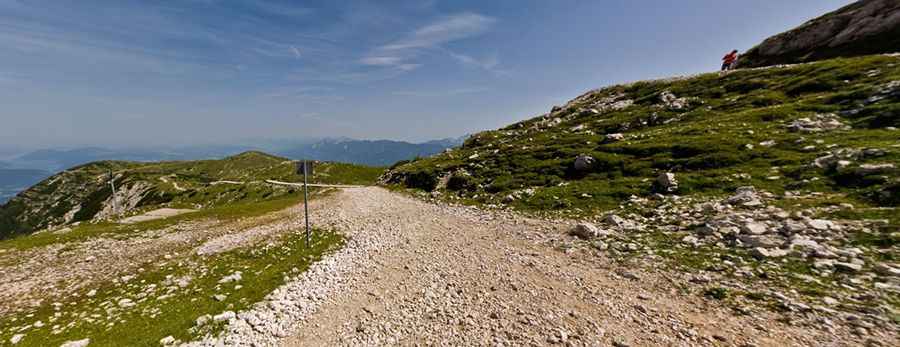
| Road facts: Dobratsch (Villacher Alpenstraße) | |
|---|---|
| Location | Carinthia, Austria |
| Elevation | 2,143 m (7,030 ft) |
| Length | 20.5 km (12.7 miles) |
| Elevation Gain | 1,603 m (5,259 ft) |
| Average Gradient | 7.81% |
| Surface | Paved (16 km) / Unpaved gravel (final 4.2 km) |
Where is the road to Dobratsch?
Located in southern Austria near the Italian and Slovenian borders, the peak sits within the Dobratsch Nature Park in the Gailtal Alps. The access route starts in Villach on the Drava River and follows the Villacher Alpenstraße, a private toll road that climbs the mountain massif.
Is the road to the Dobratsch summit paved?
The road changes surface near the top. The first 16 kilometers from Villach to the Rosstratte parking lot (1,732 meters) are fully paved, wide, and well-maintained. Beyond Rosstratte, the remaining 4.2 kilometers to the 2,143-meter summit are an unpaved gravel track. Public motorized traffic ends at Rosstratte; the final dirt stretch is restricted to authorized service vehicles, emergency personnel, and maintenance trucks heading to the transmitter tower.
How steep is the drive to Dobratsch?
Starting from Villach, the 20.5-kilometer climb gains 1,603 meters of vertical elevation. The route maintains a sustained average gradient of 7.81%, with ramps reaching 10% to 12% in several sectors. The climb includes 9 sharp hairpin turns. The continuous gradient forces engines to work hard in low gears during the ascent, while the long descent requires engine braking to prevent brake overheating.
When is the road to Dobratsch open?
The paved Villacher Alpenstraße toll road is open year-round up to the Rosstratte parking lot, though heavy winter snowstorms can temporarily close the upper sections until plows clear the asphalt. The best driving conditions are between May and October. High winds and sudden mountain fog frequently hit the upper ridges, reducing visibility along the hairpins.
Pic: Markus Ortner