How to drive the damaged military track to Shkarpa Peak?

Shkarpa Peak is a high mountain summit at an elevation of 2,460m (8,070ft) above sea level, situated on the border between Kosovo and North Macedonia within the Shar Mountains (Šar Planina). The access route is an unpaved military track constructed in 2001, which has received zero maintenance for over two decades. Logistically, the road is in a state of advanced decay, making it a technical 4x4 sector that requires high ground clearance and specialized off-road tires to navigate the eroded surfaces. It's one of the highest roads in the country.
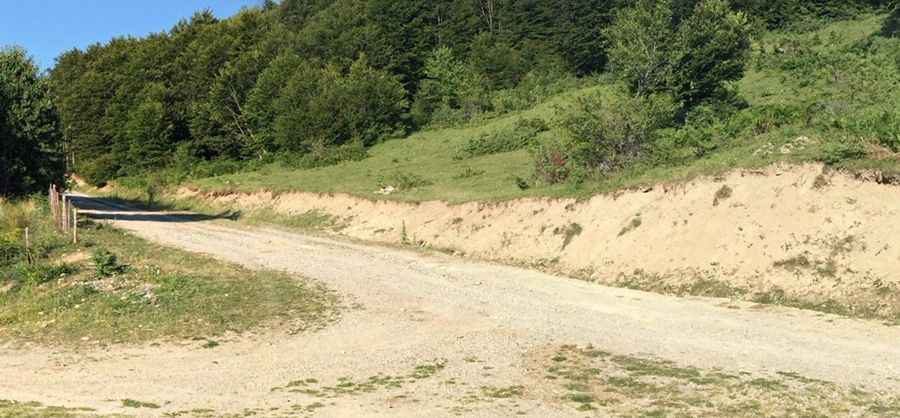
Shkarpa Peak
Road facts: Shkarpa Peak
Location Kosovo (Zaplluxhe) - North Macedonia Border
Elevation 2,460m (8,070ft)
Length 10 km (from Zaplluxhe)
Average Gradient 11.56%
Max Gradient 15% in eroded hairpins

What are the driving hazards on the Shkarpa Peak ascent?

Starting from Zaplluxhe, the 10 km climb to the summit involves a massive elevation gain of 1,156 meters. The resulting average gradient of 11.56% is aggravated by the total lack of road maintenance. The surface is composed of large loose rocks and deep rain-washed gullies that can easily high-center a standard SUV. Technical driving is required to manage the steep hairpins, where the absence of a stable roadbed often forces the vehicle to climb on exposed bedrock. Traction is minimal, and the risk of sidewall damage from sharp stones is a constant hazard for any vehicle attempting the ascent.

What are the technical logistics of the Shar Mountains border track?

Reaching 2,460 meters in this sector of the Balkans puts extreme stress on the vehicle’s transmission and cooling systems. The track was originally built for KFOR military logistics, but current conditions have narrowed the motorable path significantly. Logistically, the summit contains the remnants of an abandoned concrete structure; there is limited space for turning around, especially if the ground is saturated by snowmelt. On the descent, the 11.56% grade necessitates the use of low-range engine braking. Relying on the service brakes on this 10 km downward transit will lead to rapid thermal fatigue and potential brake failure.

How to manage weather and isolation on Shkarpa Peak?

The Shar Mountain National Park environment is subject to severe alpine weather. Sudden thunderstorms can turn the eroded track into a high-risk drainage channel, making the 10 km sector impassable for hours or days. Visibility often drops to near zero at the summit ridge. It is a mandatory safety protocol to check the meteorological reports for both Kosovo and North Macedonia before departure. In the event of a mechanical failure, the isolation of Shkarpa Peak means that any recovery operation must be self-managed or coordinated with specialized cross-border rescue services, as there is no civilian infrastructure in the vicinity.

Vehicle requirements for the Zaplluxhe to Shkarpa route

A heavy-duty 4x4 with M/T (Mud-Terrain) tires and high ground clearance is the only viable option for Shkarpa Peak. Before starting the climb, ensure your vehicle is equipped with a full-size spare tire and a high-lift jack. Logistically, Zaplluxhe is the last point for fuel and basic supplies. It is a technical requirement to verify the integrity of the steering rack and suspension bushings, as the 10 km of unmaintained military road will subject these components to extreme vibration and impact. Carrying a winch and recovery straps is essential for any autonomous transit to the summit ridge.
Pic: Uran Halimi