How difficult is the unpaved 4x4 road to Kosh-Bel Pass in Kyrgyzstan?
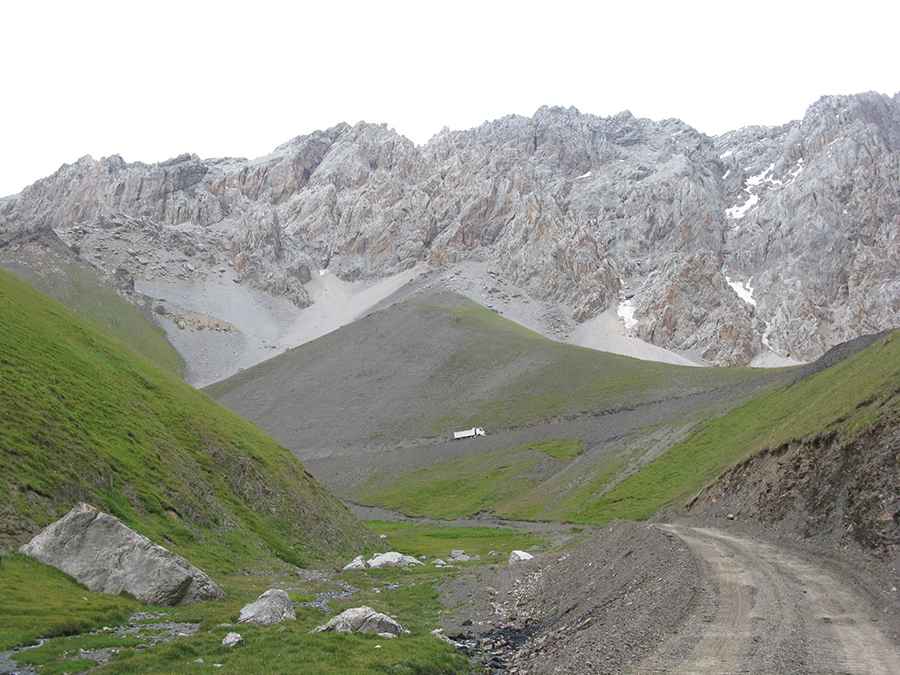
Pereval Kosh-Bel is a high mountain pass reaching an elevation of 3,577m (11,735ft) above sea level in the Kara-Suu District of the Osh Region, Kyrgyzstan. Located in the southwestern part of the country within the rugged Chalkuyruk Valley, the road is a brutal example of high-altitude logistics. This is not a route for casual exploration; it is a working track where the extreme terrain and the constant flow of heavy machinery create a driving environment that tests the structural integrity of any 4x4 vehicle.
| Road facts: Kosh-Bel Pass | |
|---|---|
| Location | Kara-Suu District, Osh Region (Kyrgyzstan) |
| Elevation | 3,577m (11,735ft) |
| Length | 76 km (47 miles) |
| Surface | Unpaved / Loose Scree / River Stones |
| Vehicle Required | Heavy-duty 4x4 with low-range |
How long is the road through Kosh-Bel Pass?
The road spans 76 km (47 miles), running east-west from Sogondu to Karagur. This is a long-haul journey through a landscape that is constantly shifting due to erosion and rockfalls. Along the way, the track also climbs over the unpaved 4x4 road to Kosh-Moynok Pass, which sits at 3,273m (10,738ft). Covering the full 76 km can take an entire day, as the average speed rarely exceeds 20 km/h due to the deep ruts and the need to navigate around heavy trucks that dominate the narrowest sections of the valley.
What are the road conditions on the Kosh-Bel summit?
The entire 76 km stretch is unpaved and in a state of permanent decay. As seen in the higher sections of the Chalkuyruk Valley, the road is often nothing more than a ledge carved into massive tarteres (scree slopes). The surface is a mix of loose, sharp stones and fine glacial dust that turns into a slippery trap after rain. The main hazard, however, is the coexistence with heavy trucks and industrial machinery. These big rigs often struggle on the steep ramps, creating deep "washboard" ripples in the dirt and kicking up clouds of dust that reduce visibility to zero for several minutes.
Why is a heavy-duty 4x4 mandatory for Kosh-Bel?
Attempting Kosh-Bel in a standard SUV is a guaranteed mechanical failure. The combination of sustained gradients and high-altitude air means your engine will be running at its thermal limit. A vehicle with a true low-range gearbox is essential for crawling over the sections where the road has been partially washed out by river crossings or meltwater. High ground clearance is also critical to avoid the "high-centering" effect in the deep ruts carved by the heavy trucks that frequent the pass. Carrying at least two spare tires and basic repair tools is a basic survival requirement in this remote part of the Osh Region.
Is Kosh-Bel Pass passable in winter?
The pass is completely closed and impassable from October until late May. At 3,577 meters, the snow accumulation is massive, and the steep slopes of the Chalkuyruk Valley are prone to avalanches that can bury the road under meters of debris. Even in early summer, the spring thaw causes significant wash-outs, making the river crossings along the 76 km route deep and dangerous. Always check local conditions before leaving Sogondu, as a sudden change in weather can leave you stranded in a communication vacuum between the two high passes of the route.
Road suggested by: Hugh Wilson
Pic: Igor Goncharov