Driving the Austrian Road to Alatajsky Pass in Kazakhstan
Alatajsky Pass, reaching an elevation of 1,792m (5,879ft) above sea level in East Kazakhstan, is the highest point of the legendary Austrian Road. This 108-kilometer unpaved track through the Sarym-Sakty Range is not a standard mountain pass; it is a decaying relic of World War I engineering that has become one of the most technical and remote off-road challenges in Central Asia. Navigating this route means dealing with a complete lack of maintenance, river crossings, and structural failures that test the limits of any expedition vehicle.
| Road facts: Alatajsky Pass | |
|---|---|
| Location | East Kazakhstan Region (Austrian Road) |
| Max Elevation | 1,792m (5,879ft) |
| Length | 108 km (67 miles) |
| Bridges/Fords | 16 technical crossings |
Why are the bridges of Alatajsky Pass so dangerous?
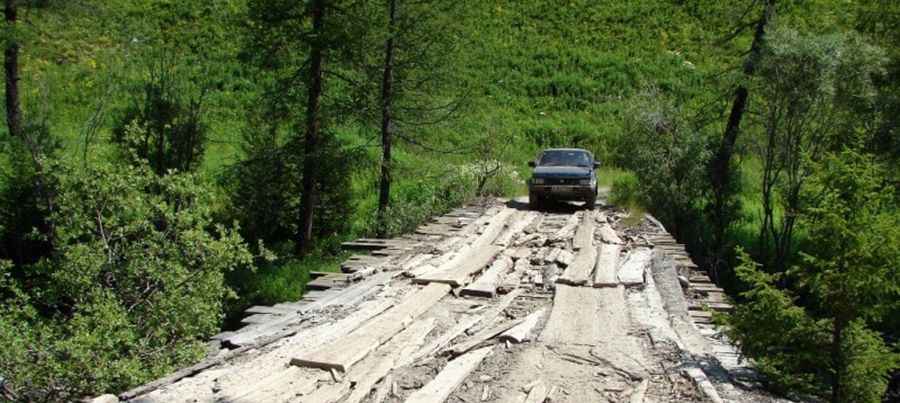
The most critical hazard when driving towards Alatajsky Pass is the state of the 16 bridges crossing the mountain streams. Built over a century ago with wooden planks and stone foundations, many of these structures are now in a state of advanced collapse. As seen in the Sorvenok Valley sections, some bridges consist of loose, rotten logs that shift under the weight of a 4x4. Crossing them requires a slow pace and often a prior inspection on foot to ensure the wood can still hold a loaded vehicle. In many cases, if a bridge is completely gone, you are forced to find a ford, which can be lethal during the spring thaw when the water levels rise rapidly.
Is the Austrian Road to Alatajsky Pass suitable for a solo drive?
Driving the 108km between Enbek and Moyildy alone is a high-consequence mistake. This area of the Katon-Karagaisky National Park is extremely remote, with no cellular coverage and zero passing traffic for days. The unpaved surface is a mix of sharp rocks, deep mud ruts, and narrow ledges that offer no margin for error. If you suffer a mechanical failure or get bogged down in a ford near the summit of Alatajsky Pass, you are on your own. Any expedition through the Sarym-Sakty Range requires at least two vehicles equipped with winches, recovery boards, and enough supplies to sustain life for several days in case the route becomes blocked by a fresh landslide.
How does weather affect the climb to Alatajsky Pass?
The Alatajsky Pass is a seasonal route that is only accessible for a few months a year, typically from late June to September. Even in summer, heavy rain turns the Austrian Road into a slick clay track where traction is non-existent. The steep gradients and never-ending hairpin turns become death traps when the soil is saturated, as the vehicle can easily slide toward the unprotected edges of the gorge. Snow can fall at 1,790 meters at any time, and once the pass is closed by winter drifts, it remains impassable until the following year. Before committing to the climb, checking the regional forecast is a mandatory protocol for survival.
What mechanical prep is needed for the Alatajsky Pass?
Preparing for Alatajsky Pass isn't about luxury; it's about mechanical survival. Your vehicle's suspension and tyre sidewalls will take a brutal beating from the jagged stones that define the Austrian Road. High ground clearance is not optional, as the ruts carved by mountain runoff can be deep enough to beach a standard SUV. You must carry extra fuel, a full-size spare, and basic tools to repair minor failures on the trail. Navigating the Alatajsky Pass is a journey back to the rawest form of driving, where the technical condition of your vehicle and your ability to read the decaying terrain are the only things keeping you moving through the Kazakh wilderness.
More info&pics: http://silkadv.com/en/content/summer-kazakhstan