Was the natural Onbashi Bridge in Japan once a road for carriages?
Onbashi Bridge (Onbashi Natural Bridge) is a massive limestone arch spanning the Dangyokyo stream in the Taishaku Gorge, Hiroshima Prefecture, Japan. Forming a natural tunnel 90 meters long and 40 meters high, this geological formation served for centuries as a functional high-road for horse-drawn carriages and mountain transit between Tojo and Jinsekikogen before modern infrastructure bypassed the gorge. It remains one of the few examples of a road that runs through a cave.
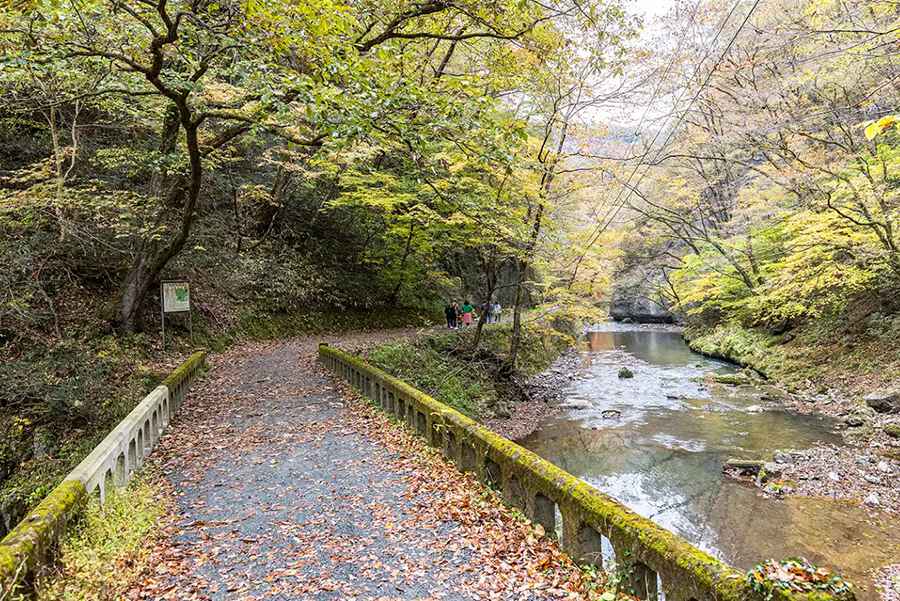
| Road facts: Onbashi Bridge | |
|---|---|
| Location | Taishaku Gorge, Hiroshima Prefecture (Japan) |
| Length | 90 meters (295 ft) |
| Height | 40 meters (131 ft) above riverbed |
| Arch Thickness | 24 meters (78 ft) thick limestone ceiling |
| Width | 18 meters (59 ft) wide internal passage |
| Historical Function | Horse and carriage mountain transit road |
| Access Restriction | Closed to motorized vehicles (Pedestrian access only) |
Where is Onbashi Bridge located?
The bridge spans the Taishaku River inside the Jinseki District of Hiroshima Prefecture, within the Bishokogen highland region of western Honshu. The site lies within the boundaries of the Hiba-Dogo-Taishaku Quasi-National Park.
How was the Onbashi natural road formed?
River erosion carved a tunnel through a solid limestone massif, creating a natural arch 90 meters long, 18 meters wide, and supported by a 24-meter-thick stone ceiling. The resulting rock floor provided a natural bridge over the gorge walls, allowing early traders to move goods without descending the cliffs.
Can you drive through Onbashi Bridge?
No. Motorized traffic is strictly prohibited across and through Onbashi Bridge to protect the geological structure. Access is restricted to foot traffic, with vehicle parking located on the regional roads leading into the Taishaku Gorge area.
What surface conditions exist on the old Onbashi track?
The original track surface consists of wet limestone bedrock, packed clay, and moss accumulation. High humidity inside the gorge keeps the stone surface slick year-round, with water dripping continuously from the cave ceiling onto the original trackbed.
Pic&more info: https://japantravel.navitime.com/en/area/jp/spot/02301-2700050/