Driving your own vehicle in China: Logistics and border requirements
Entering the People's Republic of China with a foreign-registered vehicle is one of the most complex logistical operations in the world of overlanding. Unlike most international borders, China does not recognize the International Driving Permit (IDP) and strictly prohibits independent driving for foreigners. Crossing into Chinese territory requires a minimum of three to six months of prior coordination with government-authorized agencies, a mandatory escort, and a full mechanical and bureaucratic validation of both the driver and the vehicle.
| Logistics: China Border Entry | |
|---|---|
| Mandatory Guide | Government-approved agency (24/7 presence) |
| Vehicle Requirements | Technical inspection + Temporary License Plates |
| Driver Requirements | Temporary Chinese Driving License |
| Lead Time | 90 to 180 days for permit processing |
| Sensitive Zones | Special permits for Tibet (TAR) and Xinjiang |
Why is a government-approved guide mandatory for all transits?
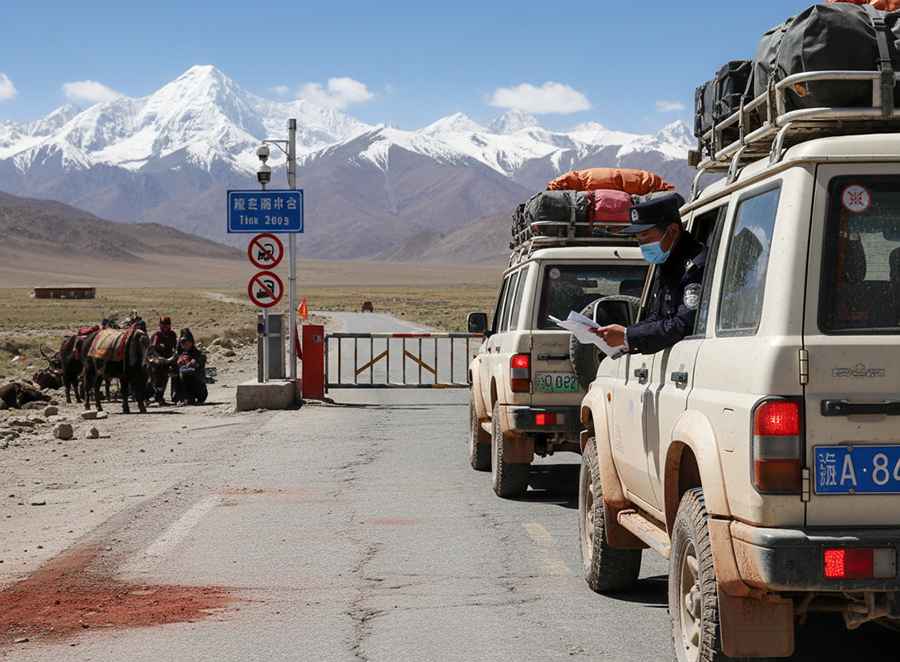
The core of Chinese driving regulations is the mandatory guide requirement. You are prohibited from operating a vehicle without a designated escort from a state-authorized agency. This is not a tourist service but a logistical necessity; the guide is responsible for your movements, hotel registrations, and navigating the hundreds of police checkpoints in sensitive regions like Xinjiang and Tibet. Every kilometer of your itinerary must be pre-approved by the military and provincial tourism boards. Deviating from the assigned track is a serious offense that can lead to the immediate impounding of your vehicle and the cancellation of your transit permits.
How to obtain temporary Chinese plates and licenses?
To legally drive, your vehicle must undergo a mandatory technical inspection upon arrival at border ports like Torugart or Irkeshtam. Chinese authorities check for mechanical integrity, including emissions, braking efficiency, and lighting. Once passed, the vehicle is issued Temporary Chinese License Plates and a specific registration document. The driver must also obtain a Temporary Chinese Driving License, which usually involves a basic medical screening for vision and blood pressure. All documentation, including your vehicle's registration (V5C or Title) and engine specifications, must be submitted and translated months in advance. Any discrepancy between your paperwork and the physical vehicle at the border will result in a denial of entry.
What are the technical hazards of high-altitude driving in China?
Beyond the bureaucracy, the physical reality of driving in Western China is a test of vehicle endurance. In the Tibetan Plateau, you will spend weeks operating at elevations exceeding 4,500 meters. The thin air causes a massive drop in engine torque and power, making heavy-duty cooling systems and clean air filters critical. In regions like Xinjiang, the "point-to-point" speed camera system is the most dense in the world, calculating your average speed between gantries to the second. Fuel logistics are also a major hurdle; in many remote sectors, foreign drivers are restricted at gas stations and must rely on their guide to authorize the pump. This is a mission of attrition where mechanical failure in a "dead zone" can leave you stranded for days waiting for specialized parts that must clear customs.
What is the best logistical strategy for a Silk Road transit?
Managing a successful drive through China requires a strictly disciplined approach. You must ensure your vehicle is in peak mechanical condition before reaching the border, as finding parts for non-Chinese models in the interior is nearly impossible. On the long mountain descents, you must rely on heavy engine braking to avoid overheating your pads, as the lower atmospheric pressure reduces brake cooling efficiency. Carry extra fuel in certified containers and prepare for constant inspections at "check-gates" where every passenger's face and passport are scanned. In the Chinese hinterland, the road is a mission—respect the strict itinerary, monitor your engine temperatures in the thin air, and ensure your logistics are handled by an agency with proven experience in military-sensitive zones.
```