Driving the S60 Hena Expressway through the Guangxi Karst peaks
The Hena Expressway (S60) is a major high-speed logistical corridor at an elevation of varying karst plateaus, located in the Guangxi Zhuang Autonomous Region of southern China. Spanning 516 kilometers (320 miles), the S60 connects Hepu County to Napo County, traversing some of the most complex limestone topographies in Asia.
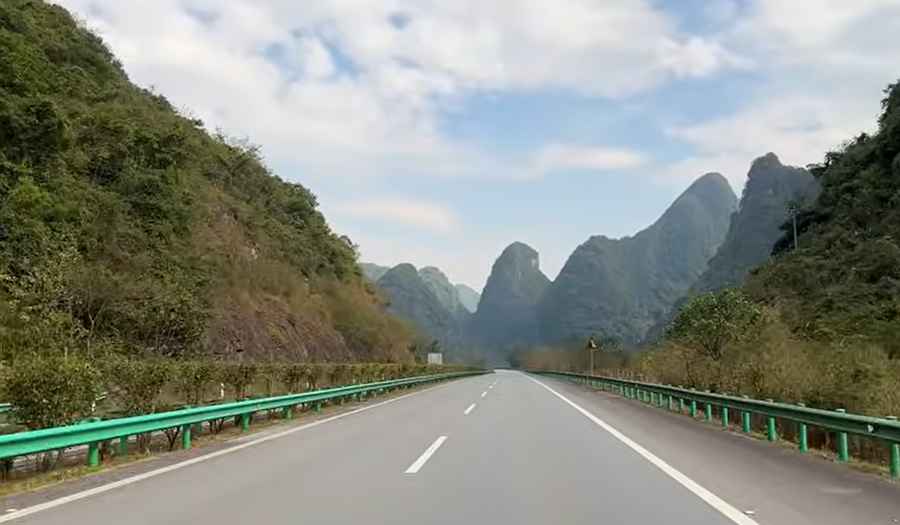
| Road facts: Hena Expressway (S60) | |
|---|---|
| Location | Guangxi, China (Vietnam Border) |
| Length | 516 km (320 miles) |
| Bridge/Tunnel Ratio | 31% of total length |
| Speed Limit | 100 km/h (62 mph) |
| Key Structure | Baida Viaduct |
What are the engineering challenges of the S60 Hena Expressway?
Constructed between 2013 and 2016, the S60 Hena Expressway was a massive logistical operation due to the regional karst topography. Technically, the route requires a 31% ratio of bridges and túnels to maintain a constant 100 km/h speed limit through isolated limestone peaks. The most critical structure is the Baida Viaduct, which spans deep gorges to connect three distinct mountain ranges. Logistically, the engineering had to account for the unstable nature of karst foundations, requiring deep-piling techniques and seismic reinforcement to ensure the structural integrity of the elevated sections.
What are the driving hazards on the "Road to Heaven"?
Despite its modern asphalt surface, the Hena Expressway presents specific high-speed driving hazards. Technically, the primary risk is sudden visibility loss due to persistent low-level clouds and mountain mist characteristic of the Guangxi region. Logistically, the 516 km transit includes frequent transitions between high-exposure viaducts and long tunnel systems, requiring rapid ocular adjustment to changing light levels. Drivers must maintain strict lane discipline, as the proximity to the China-Vietnam border means the road is used by high-tonnage freight vehicles that can affect aerodynamic stability during overtaking maneuvers on elevated bridges.
Is the S60 Expressway affected by seasonal weather?
The S60 operates year-round, but its logistical efficiency is subject to the subtropical climate of southern China. Technically, the road surface is designed for high-volume drainage, but heavy monsoon rains can trigger hydroplaning risks on the viaduct sectors. Logistically, the karst peaks are prone to localized rockfalls, although most critical slopes are stabilized with technical netting. Before attempting the 516 km drive to Napo County, drivers should verify brake and tire condition, as the sustained 100 km/h speeds on elevated structures require optimal mechanical response to handle the high-vibration environment of the Baida Bridge and surrounding infrastructure.
Pic&video: 中国街景 China Street View