Driving the steep Yangtianshan Panshan Road in Shandong
The Yangtianshan Panshan Road (also known as Jiulong Pan or Nine Dragons Winding Road) is a mountain road located within the Yangtianshan Natural Scenic Area in Linqu County, Shandong Province, China. The paved route climbs the steep slopes of the mountain through a series of continuous hairpin turns.
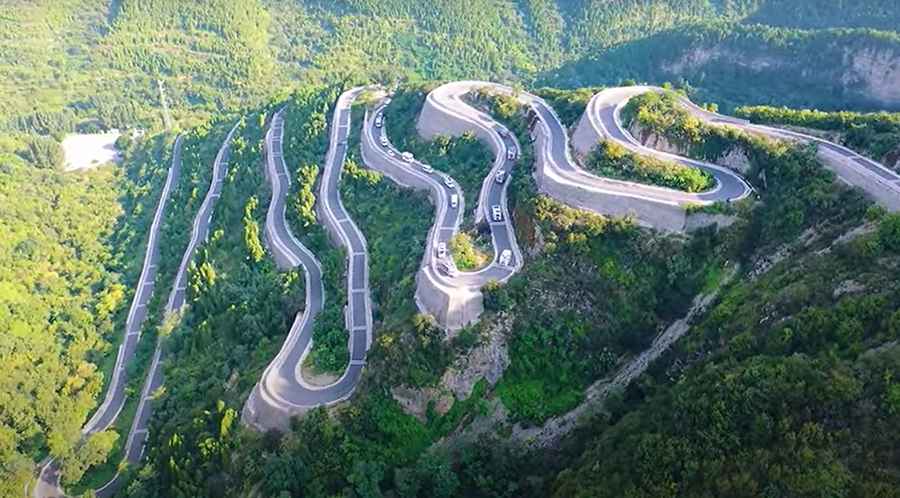
| Road facts: Yangtianshan Panshan Road | |
|---|---|
| Location | Linqu County, Shandong Province (China) |
| Length | 3.5 km (2.17 miles) |
| Road Width | ~6 meters (19.6 ft) |
| Max Gradient | 13% |
| Hairpin Turns | 12 switchbacks |
| Surface | Paved asphalt |
Where is the Yangtianshan Panshan Road located?
The road is situated in eastern China's Shandong Province, roughly 46 kilometers southwest of Qingzhou City. It serves as the primary paved access route climbing toward the summit area of the Yangtianshan Natural Scenic Reserve.
How steep is the Yangtianshan Panshan Road?
The 3.5-kilometer climb scales the slope via 12 tightly stacked hairpin turns. The road averages a steep incline with maximum ramps reaching 13%. The asphalt width is approximately 6 meters, providing a narrow two-lane surface with minimal straight sections between switchbacks.
What hazards exist on the Yangtianshan Panshan Road?
Continuous 13% gradients put heavy demand on vehicle cooling systems during the climb and require low gears on the descent to prevent brake pad overheating. The road is bounded by concrete retaining walls and protective barriers along steep drops. During peak tourist seasons in spring and autumn, local shuttle buses and visitor traffic create congestion on the narrow switchbacks.
Is the Yangtianshan Panshan Road open in bad weather?
Rain or light winter snow makes the 13% paved ramps slippery, reducing tire traction on the hairpins. Mountain fog frequently lowers visibility through the blind turns. Local scenic area authorities temporarily restrict access during heavy storms or icing conditions.
Road suggested by: jorge manuel gómez sánchez
Pic&video: Aerial China