How to manage the 25% gradients of the S315 road to Lach La?
Lach La is a high-altitude mountain pass at an elevation of 4,731 meters (15,521 ft) above sea level, located in Nangqên County, within the Qinghai province of China. The pass is crossed by the S315 road, a high-mountain route connecting Xiangdazhen and Zhuoxiao that features extreme ramps reaching up to 25% gradient.
| Road facts: Lach La (S315) | |
|---|---|
| Location | Nangqên County, Qinghai (China) |
| Elevation | 4,731 m (15,521 ft) |
| Length | 74.7 km (46.4 miles) |
| Max Gradient | 25% |
| Surface | Paved (Paved in the early 2020s) |
Is the S315 road to Lach La paved?
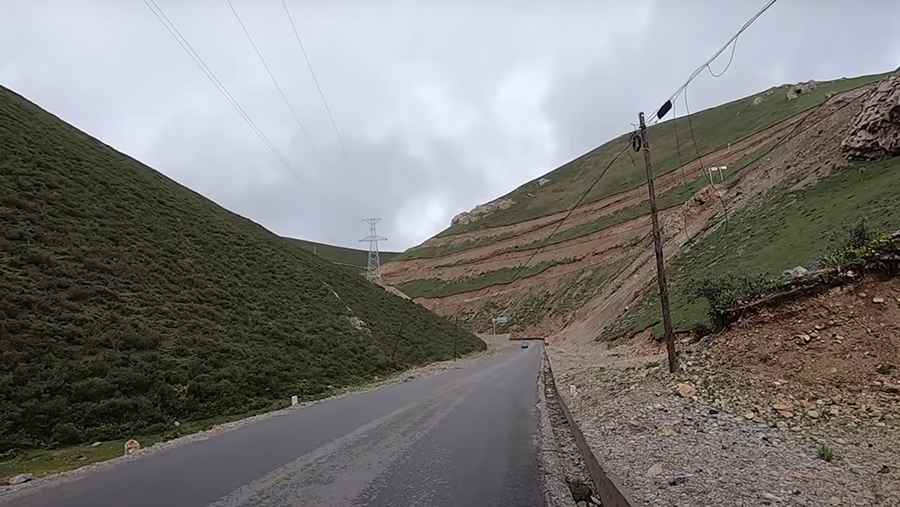
Historically a rough dirt track, the S315 road was fully paved in the early 2020s. Today, smooth dark asphalt covers the 74.7-kilometer drive between Xiangdazhen and Zhuoxiao. However, despite the modern surface, the road lacks guardrails, and the steep, unreinforced slopes alongside the pavement frequently drop rocks and loose soil onto the lanes after rain or snowmelt.
How steep is the drive over Lach La?
The climb over Lach La includes extreme sections with ramps reaching a 25% gradient. At 4,731 meters above sea level, the thin air reduces engine power significantly, forcing cars to stay in low gear to maintain momentum on the steepest pitches. Stopping on a 25% ramp at this altitude puts heavy strain on the clutch and transmission when trying to start moving again.
How to manage the high-altitude descent from Lach La?
The drive through the pass takes between 3.5 and 4 hours under good conditions. On the long downhill stretches from the summit, continuous heavy braking will quickly overheat the brakes. Drivers must shift into a low gear to let engine braking control the speed on the steep 25% drops.
What are the hazards on the Lach La pass in Qinghai?
The main hazard on the S315 is the unpredictable weather of the Qinghai-Tibet Plateau. At over 4,700 meters, sudden snowstorms, ice, or mudslides from the exposed mountain cuts can slow traffic or block the road entirely. There are no gas stations or towns along the high-altitude section, so vehicles must start the drive with a full tank of fuel.
Road suggested by: Hugh Wilson
Pic&video: Tumble Home Visions