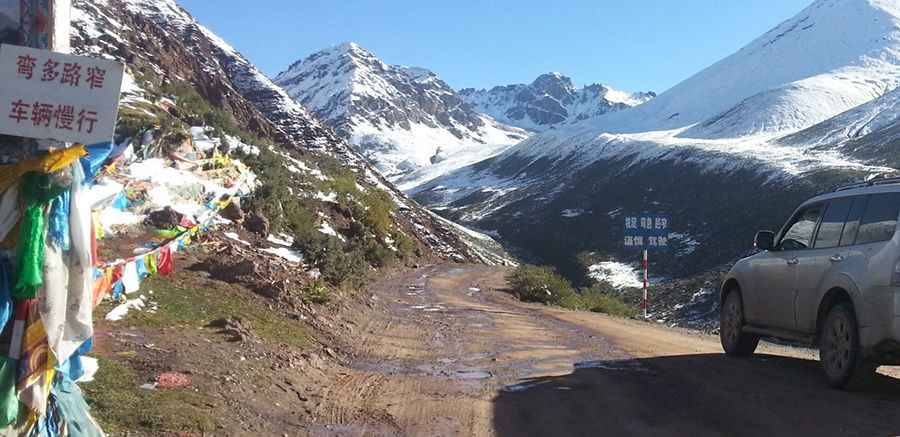
Driving the unpaved and muddy road to Zholpel La
Zholpel La is a brutal high-mountain pass sitting at 4,615 meters above sea level in the Qamdo district of eastern Tibet. Part of the legendary China National Highway 317, also known as the Northern Sichuan-Tibet Highway, this pass is a chaotic mix of mud, loose gravel, and thin air. While a modern tunnel now bypasses the most treacherous sections, the original surface route over the Tannyaintangoin Mountains remains a technical nightmare for anyone driving a heavy vehicle or a standard 4x4 through the high-altitude slush.
| Road facts: Zholpel La | |
|---|---|
| Location | Qamdo, Tibet, China |
| Elevation | 4,615m (15,141ft) |
| Length | 62 km (38.5 miles) |
| Surface | Unpaved / Mud / Rocky |
How difficult is the unpaved road to Zholpel La?
The 62-kilometer stretch between Bindaxiang and Eluozhen is a grueling test of traction. As seen on the ground, the road surface is an unpredictable layer of mud and meltwater that can hide deep ruts and sharp rocks. Even with the bypass tunnel available, the old route—known also as Zhu Jiao La or Trugu La—remains a vital but dangerous track. The incline is steep and the corners are often "tippy," where the weight of the vehicle shifts toward the outer edge of the mountain. You need a high-clearance vehicle with aggressive tires; if you try to drive this with standard road tires, you will spend most of the trip spinning out in the high-altitude muck.
What are the main hazards when driving the G317 at 4,600m?
The primary hazard at Zholpel La is the combination of extreme altitude and road instability. At over 4,600 meters, your engine's power will drop by nearly 40%, making the muddy climbs feel like an impossible task for a weak motor. Snowstorms can hit at any time of the year, instantly turning the gravel into a slippery trap. The lack of safety barriers means that any slide on the muddy corners could send you over the side. Furthermore, the local signage warns drivers to keep a slow, disciplined pace; the vibration from heavy furgonetas up and down the pass often causes small rockfalls that litter the driving lane with jagged limestone that can easily slice a sidewall.
What mechanical prep is needed for the Zholpel La crossing?
Before you commit to the climb, ensure your 4WD system and diff locks are fully functional. The mud on this pass is thick and sticky, and you will need all the torque you can get. Check your cooling system; at this altitude, the air is too thin to cool the radiator effectively during a long, low-gear crawl. On the descent, do not rely on your brakes. The combination of the steep gradient and the weight of a loaded vehicle will smoke your pads within kilometers. Use engine braking and keep your speed under control. Carry at least two full-sized spare tires, extra fuel, and recovery gear like a winch or sand plates, as the isolation in this part of Tibet means that help could be days away if you get bogged down in the high-altitude slush.
Road suggested by: Jorge Manuel Gómez Sánchez
Pic: Paul Wood