How to drive the 100 hairpins of Chuti Chang La?
Chuti Chang La, also identified as Quidijiankela Pass, is an extreme high-altitude mountain pass reaching 5,047m (16,558ft) above sea level. Located on the Line of Actual Control (LAC) between China (Tibet) and India (Ladakh), the road serves as a vital military link between Pangong Tso and Spanggur Tso. This 29 km unpaved route is one of the most technically demanding tracks in the region, featuring a vertical climb managed through more than 100 sharp hairpin turns.
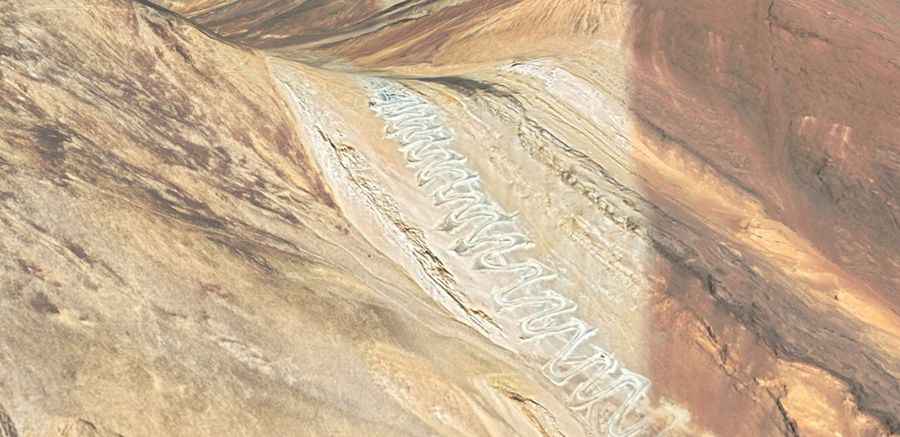
| Road facts: Chuti Chang La | |
|---|---|
| Location | LAC (Pangong Tso to Spanggur Tso) |
| Elevation | 5,047 m (16,558 ft) |
| Length | 29 km (18 miles) |
| Technical Features | 100+ hairpin turns |
| Access | Strictly Military / 4x4 only |
What are the driving logistics for the 100 hairpins of Chuti Chang La?
The 29 km ascent to Chuti Chang La is a masterclass in mountain engineering, utilizing over 100 hairpins to overcome the extreme gradient. Logistically, navigating these switchbacks requires a short-wheelbase 4x4 vehicle to manage the tight radii without needing multi-point turns. The surface is raw unpaved scree, meaning traction is inconsistent. Drivers must maintain a constant torque flow, as stopping on the steeper sections of the Quidijiankela Pass can lead to wheel spin and surface erosion, making restarting the climb technically difficult. Using low-range (4L) gear is a mandatory protocol to control power delivery and reduce stress on the transmission.
How does the 5,047m altitude affect vehicle performance on Chuti Chang La?
Reaching the summit of Chuti Chang La at 5,047 meters puts the vehicle's engine under extreme atmospheric stress. At this elevation, the air density is roughly 50% of that at sea level. Logistically, this results in a massive drop in power for non-turbocharged engines and places a heavy load on the turbocharger for modern diesel units, which must spin significantly faster to compensate for the thin air. Monitoring the coolant temperature is critical; the boiling point of water drops significantly at this altitude, increasing the risk of cavitation and engine overheating during the slow, high-load climb through the 100+ turns.
What is the technical infrastructure at the Chuti Chang La summit?
The summit of Chuti Chang La is not merely a transit point but a fully operational military outpost. Logistically, the base must be self-sufficient, relying on solar panels and backup generators to maintain electrical systems in sub-zero temperatures. The site includes water tanks and bathrooms engineered for permafrost conditions. For any logistical transit, the 5,047m summit represents the highest point of mechanical strain. The lack of infrastructure for hundreds of kilometers means that any vehicle attempting the route from Pangong Tso must carry a full suite of spare parts, including belts, hoses, and electrical sensors, as the extreme vibration from the unpaved track can cause sudden component failures.
What are the descent logistics and braking safety on Chuti Chang La?
The 29 km descent from the Chuti Chang La summit towards the Spanggur Tso lakes requires disciplined braking protocols. Relying on the service brakes across more than 100 turns will inevitably lead to brake fade. Technically, the use of heavy engine braking is the only safe way to manage the decline. On the loose gravel surface of the Quidijiankela Pass, braking must be done in a straight line before entering the apex of each hairpin to avoid front-end washouts. Furthermore, the road is strictly closed to civilians, meaning that military convoys have absolute priority; logistically, this requires pull-over maneuvers on the narrowest sections of the shelf road to allow armored units to pass.
Road suggested by: Jorge Manuel Gómez Sánchez