Driving the A77: The rugged mountain road through Kōtal-e Nāwêr and Mullā Ya‘qūb
The A77 is a daunting high-mountain road located in central Afghanistan, crossing through the Maidan Wardak and Bamiyan provinces. Spanning 135 km (84 miles) of unpaved terrain, this remote track summits two major mountain passes—Kōtal-e Nāwêr and Kōtal-e Mullā Ya‘qūb—offering a true backcountry driving experience along the river valleys of the Hindu Kush.
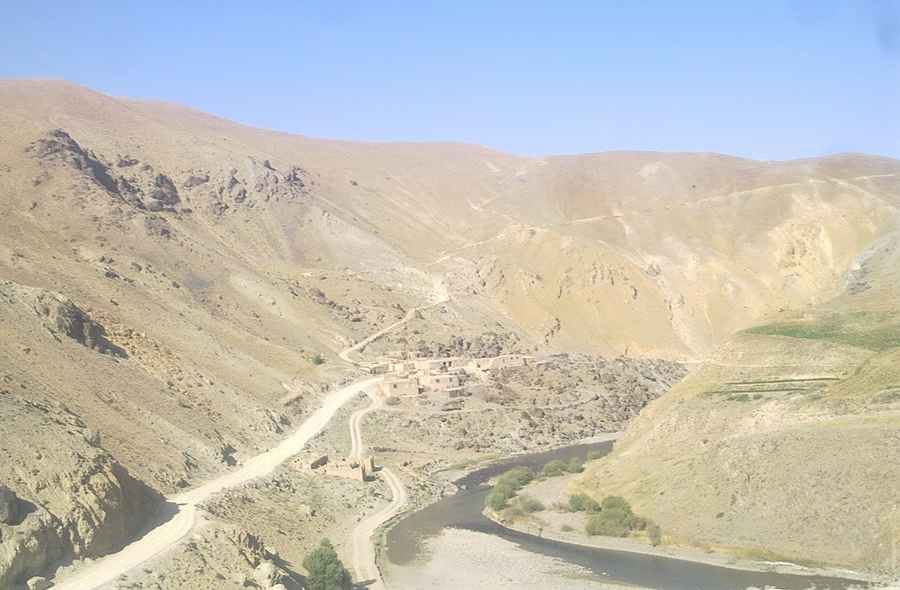
| Road facts: Highway A77 (Zarkharid to Panjab) | |
|---|---|
| Location | Maidan Wardak & Bamiyan, Afghanistan |
| Length | 135 km (84 miles) |
| Max Elevation | 3,077 m (10,095 ft) at Kōtal-e Nāwêr |
| Surface | Unpaved / Dirt and Rock |
| Hazard Level | Extreme (Steep drops & No guardrails) |
Where does the A77 mountain road lead?
The route runs east-west, connecting the settlements of Zarkharid and Panjab via Band-e Shuy. For a significant portion of its 135 km length, the A77 follows the natural course of a mountain river, winding through deep canyons and high plateaus. It serves as a vital, though perilous, connection between the isolated communities of the central highlands.
What are the two major passes on the A77?
Driving the full length of this section involves summiting two distinct high-altitude points:
- Kōtal-e Nāwêr: The highest point of the route at 3,077m (10,095ft). This pass offers expansive views but is notorious for its steep, winding sections.
- Kōtal-e Mullā Ya‘qūb: Located further east at an elevation of 2,745m (9,005ft), this pass marks a critical transition point in the mountain terrain.
What are the driving conditions on the A77?
The road is entirely unpaved and in a primitive state. Drivers must navigate a surface consisting of loose dirt, rocks, and sand. The track is extremely narrow in several places, carved directly into the cliffside with sheer drops and no guardrails. The proximity to the river means that during the spring thaw or after heavy rains, sections of the road can become flooded or completely washed out.
Is Highway A77 safe for all vehicles?
No, this is a high-risk road that is not recommended for inexperienced drivers or standard passenger cars. A high-clearance 4x4 vehicle is mandatory to handle the uneven terrain and steep gradients. Due to the extreme isolation of the Maidan Wardak and Bamiyan provinces, travelers must be fully self-sufficient, carrying enough fuel, water, and emergency supplies, as there are no services along the 135 km stretch.
When is the best time to travel through these passes?
Accessibility is highly seasonal. During the winter months, heavy snowfall frequently blocks both Kōtal-e Nāwêr and Kōtal-e Mullā Ya‘qūb, making the A77 impassable for months. The best window for driving is usually from late spring to early autumn, although travelers should always be prepared for sudden mountain weather changes and localized landslides.
Road suggested by: Hugh Wilson
Pic: Hasan Malistani