Left-to-Right: How Border Crossings Handle Side-of-the-Road Changes
While 66% of the world’s population drives on the right, the remaining 34% adheres to the left-hand side. This global division creates a unique engineering challenge: the border crossover. In several regions across Africa, Asia, and South America, drivers must transition from one side of the road to the other while crossing international boundaries.
To understand the global landscape of these regulations, you can explore our comprehensive list of left and right driving countries. However, the real magic happens at the physical borders, where ingenious road designs ensure that this transition is safe and fluid for motorists.
| Border Crossover Facts | |
|---|---|
| Total Crossover Borders | ~15 active locations worldwide |
| Transition Methods | Bridges, flyovers, and signage systems |
| Key Regions | South-East Asia, Southern Africa, South America |
Where neighboring countries drive on opposite sides, simple road signs are rarely enough. Engineers have developed various architectural solutions—from "flipping" bridges to complex flyovers—to help drivers cross over without confusion. Below are five remarkable examples of border engineering that showcase this transition.
Lotus Bridge (Macau – China)
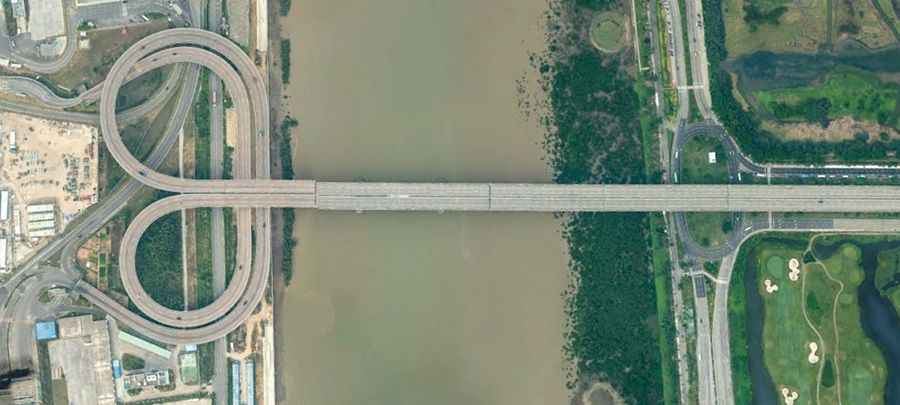
Located between Macau and Mainland China, this bridge uses a clever 360-degree loop to swap traffic sides seamlessly.
Thai – Lao Friendship Bridge (Thailand – Laos)
Connecting Nong Khai with Vientiane, the switch between Thailand (left) and Laos (right) is managed near the border terminal.
Shenzhen Western Corridor (Hong Kong – China)
The crossover bridge between Hong Kong and Shenzhen is a high-speed example of how infrastructure handles side-switching for thousands of daily vehicles.
Poipet (Thailand – Cambodia)
A bustling land crossing where drivers must adapt as they pass through the international gateway between Thailand and Cambodia.
Channel Tunnel (UK – France)
The link between the United Kingdom and France requires a major psychological and physical shift in driving orientation upon exiting the terminals.