Remarkable Bridge Crossings That Add Character to Scenic Roads
One bend in the road can lift you above open surf or drop you into a quiet timber tunnel before your coffee cools. Great scenic bridges do more than span obstacles; they frame the view, hint at local history, and turn a simple drive into the main event.
This guide breaks down what makes a road crossing memorable, how structural choices like timber and viaducts fit different landscapes, and standout routes to explore from Norway’s coast to the Florida Keys.
What Makes a Bridge Memorable?
A dramatic backdrop helps, yet the structure itself shapes how you experience the scenery. Sweeping arches or slender cables can frame a distant horizon like a lens, while natural materials let a span blend seamlessly into the terrain. Even the approach builds anticipation, especially when a winding road keeps the crossing hidden until the final bend.
Bridges also serve as open-air history lessons. Hand-laid stone abutments, riveted steel trusses, or preserved nineteenth-century spans reveal how earlier engineers solved the same terrain with the tools of their era.
Bridge Crossings on Scenic Roads
Not every unforgettable crossing has to tower hundreds of feet above a gorge. A warm timber span tucked along a wooded hollow can feel just as magnetic as a soaring concrete viaduct, and often fits the drive far better.
On two-lane rural parkways and forest routes, engineers face a practical challenge: carrying everyday traffic and heavy trucks without interrupting the natural scenery with harsh concrete or steel. Builders solve this by pairing heavy-duty treated timber girders below with exposed wood railings and decking above. Real-world double-lane timber vehicular bridges, such as the crossings documented by York Bridge Concepts, show how structural wood can handle modern highway loads while keeping the roadway visually grounded in the surrounding trees.
Next time you cruise a scenic backroad, watch for the subtle design choices that give a bridge its personality:
- Sightline curves that gradually reveal water, valley, or forest views as you approach
- Local materials like stone, weathered steel, or timber that echo the surrounding terrain
- Historic details such as truss patterns or timber joinery that reflect how the region was built
Crossings Worth Exploring
Each of these bridges gives drivers a different way to experience the landscape. Some carry travelers over open water, while others connect them to a sweeping valley or a town’s quiet history. Together, they show why the crossing itself can be as memorable as the final destination.
Norway’s Atlantic Ocean Road
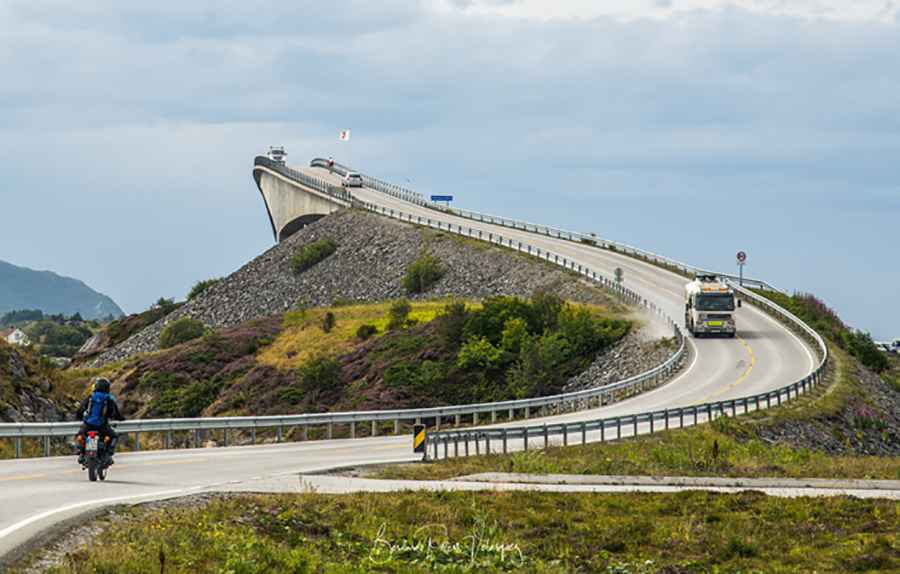
The Atlantic Ocean Road winds among rocky islands along Norway’s coast. Its best-known crossing, the Storseisundet Bridge, rises and curves above the water. Depending on your approach, the shape can make the road ahead look surprisingly steep.
Designated as one of the official Norwegian Scenic Routes, the road keeps drivers right at sea level between low-lying skerries, making the crossing feel immersed in the North Atlantic rather than elevated above it.
Seven Mile Bridge in the Florida Keys
Seven Mile Bridge gives drivers a long look at the water between islands in the Florida Keys. According to the Florida Department of Transportation, the modern bridge is approximately 6.8 miles long. As you cross, water stretches out on both sides of the roadway.
Parts of the older bridge remain nearby, offering a glimpse into an earlier era of Keys travel. Seeing the structures together adds a sense of history to a drive already known for its views.
France’s Millau Viaduct
The Millau Viaduct carries traffic high above France’s Tarn Valley. Its tall supports and slender roadway stand out against the broad landscape. From a distance, the bridge looks remarkably light for a structure carrying a major road.
The view changes as you get closer. Rather than simply passing around the valley, drivers travel across it, with the surrounding countryside opening up beyond the roadway.
Vermont’s Covered Bridges
Vermont’s covered bridges offer a smaller, quieter experience. Their timber sides and roofed entrances create a brief passage through the structure before the road opens up again. On a rural drive, they can feel like natural extensions of the towns and rivers around them.
Take posted height and weight limits seriously before entering. Older bridges need protection from vehicles that are too large or heavy, and paying attention helps preserve them for future travelers.
Turn Scenic Road Bridges Into Your Next Drive
A coastal span, a timber crossing, or a high viaduct can reshape how you experience the road long before your final stop. Each structure adds its own character to the route and turns a simple drive into something worth remembering.
Map out bridges and safe pull-offs before you set out. Giving yourself time to pause where permitted lets you take in the setting and notice how each crossing fits its surroundings.
Image Attribution: Pixabay.com royalty-free image #7273742, 'norway, atlantic road, bridge, architecture, road, landscape, atlantic road, atlantic road, atlantic road, atlantic road, atlantic road' uploaded by user Bernardo_Peters, retrieved from https://pixabay.com/photos/norway-atlantic-road-bridge-7273742/ on November 25th, 2026. License details available at https://pixabay.com/en/service/terms/#usage - image is licensed under Creative Commons CC0 license