Caught in a Hailstorm on Texas Roads: How to Stay Safe Behind the Wheel and Protect Your Roof Afterward
Texas drivers caught in hail should slow down, pull over safely, and stay inside the vehicle. Hail of 1 inch or larger is classed as severe, and Texas logged 902 such events in 2025. After the storm, the roof at home needs a professional check as well.
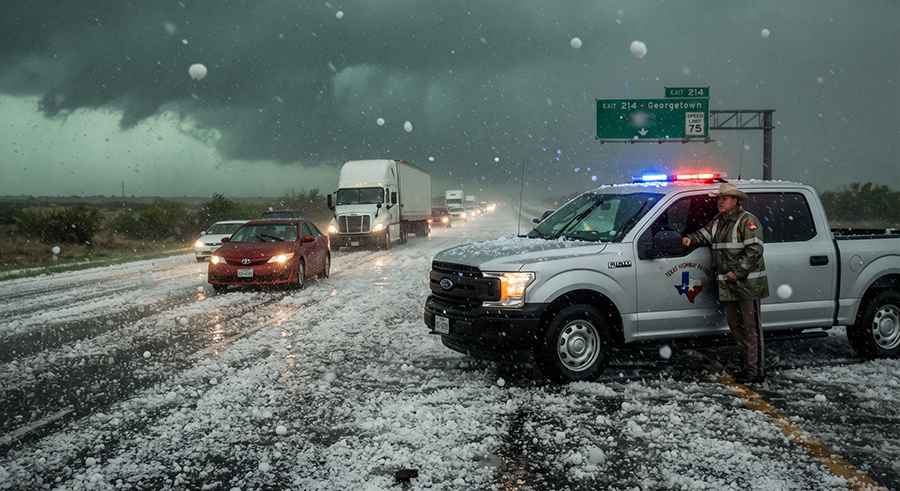
This guide covers both halves of a hailstorm: the minutes on the road and the days after it. We drew the figures from the Insurance Information Institute, the National Weather Service and the Texas Department of Insurance. Each section opens with its direct answer, so readers can jump to the part they need.
Why Texas Roads See So Much Hail
Texas leads the nation in major hail events. The Insurance Information Institute counted 902 major hail events in Texas in 2025, against 5,432 across the United States. Kansas ranked second with 375, Oklahoma followed with 369, and Nebraska and Missouri logged 315 and 253.
Each of those events means hailstones of 1 inch or larger, about the size of a quarter. Texas therefore logged more than twice the events of any other state on the list. A highway offers no cover, so we treat every Texas storm warning as a driving decision. Drivers who check the forecast before a long trip have time to choose a route with places to stop.
What to Do When Hail Hits While You Drive
Drivers caught in hail should slow down, pull over and stay clear of other vehicles, according to AAA Texas. Speed matters because driving compounds the impact of each hailstone on your car. Four habits keep you safer:
- Slow down early. A lower speed reduces the force of every strike on the glass and body.
- Leave the traffic lanes. Pull onto a shoulder or another safe spot instead of stopping in a lane.
- Stay inside the vehicle. Falling hail is fast enough to injure anyone standing outside.
- Point the front into the storm. Progressive advises positioning the car so hail hits the windshield, which is reinforced, unlike the other windows.
How Hail Size Translates Into Damage
The National Weather Service sorts hail into four categories by diameter. Each category carries its own damage level. The table shows where a quarter-sized storm sits on that scale.
Hail size | Everyday comparison | NWS damage level |
Under 1 inch | Peas to nickels | Small hail |
1 to 1.75 inches | Quarters to golf balls | Minor damage |
1.75 to 2.75 inches | Golf balls to baseballs | Moderate damage |
Over 2.75 inches | Larger than baseballs | Major damage |
Minor damage starts at 1 inch, the same threshold that defines a severe storm. Hail under that size stays in the small category, from peas to nickels. Giant hail above 2.75 inches causes major damage. That is why even a quarter-sized storm justifies a roof inspection.
What Hail Does to a Roof While You Are Away
The roof covering and the deck beneath it form a Texas home's first line of defense. The Texas Department of Insurance names high winds, rain and hail as the threats. We treat any storm with 1 inch hail or larger as a reason to book a professional inspection.
TDI's repair guidance gives homeowners specific products to ask about. It points to asphalt shingles tested to ASTM D 3161 Class F or ASTM D 7158 Class H. It also recommends impact-resistant skylights tested to ASTM E 1886 and E 1996 in hail-prone areas. Those ratings give homeowners a concrete question for any contractor's estimate.
Storm Weather Is a Road Hazard Beyond Texas
Colorado logged 244 major hail events in 2025, which placed it sixth among states. The state is home to the Million Dollar Highway, where winter weather can bring restrictions and closures. The route runs about 25 miles between Silverton and Ouray, and the road is typically open all year.
The Beartooth Highway carries a high hazard rating for rapid weather changes, and snow and ice can remain on its surface in mid-summer. We advise checking the forecast before any mountain route. Readers can browse more US routes in our list of the most dangerous roads in the USA.
What to Check on Your Roof After a Storm
Homeowners should call a contractor instead of climbing onto a hail-damaged roof. Safety experts quoted by CBS News Texas advise contacting the insurance company and a contractor for the inspection.
TDI also lists the checks that protect homeowners after a storm:
- Verify the contractor's name, address, phone number and references.
- Confirm the contractor carries insurance or a bond.
- Collect at least three written bids and get all agreements and warranty terms in writing.
TDI also warns against contractors who go door to door, accept only cash, or ask for money before materials arrive. It adds that contractors with only out-of-state references or no local address deserve extra caution.
Why a BBB Accredited Roofer Is Worth Checking After a Hailstorm
A BBB Accredited roofer has applied to the Better Business Bureau and been reviewed against its eight Standards for Trust. That review leaves homeowners with a public record to check before they sign a repair contract. We treat accreditation as a useful first filter, not a guarantee of workmanship.
What Accreditation Involves
BBB Accreditation is voluntary. A business applies, is reviewed against the Standards for Trust and pays dues, and BBB then monitors it against those standards. BBB can revoke accreditation when a business stops meeting them. Applicants must also have served customers for at least six months, so an accredited roofer has a track record rather than a brand-new listing.
How the Rating and Accreditation Differ
BBB letter ratings run from A+ to F. They come from a business's complaint history, how it responds to complaints, how transparent it is about its practices, and any licensing or government action against it. Customer reviews do not affect the rating, and dues do not buy one. Accreditation and the letter grade are two separate checks, so a roofer with both gives homeowners two signals instead of one.
A roofer without accreditation is not automatically a poor choice. BBB notes that the status can mean a business has not applied, did not meet the standards, or chose not to pursue it. On its own, it is not a mark against the business, so we read the rating and complaint history on the profile for the full picture.
How to Use a BBB Profile Before Hiring
A BBB Business Profile shows the rating, accreditation status, customer reviews and complaint history in one place. We suggest reading it alongside the TDI checklist above: confirm the contractor's address and references, ask about insurance or a bond, and compare three written bids. Some Austin contractors also display this information on their own sites. LOA Roofing & Construction, for example, lists its A+ BBB rating and accredited status on its Austin roofing page, with a link to its BBB profile.
Making Your Choice
Hail safety comes down to two decisions: how to drive through the storm and who inspects the roof afterward. Pulling over, staying inside and pointing the windshield into the hail protect you on the road. After the storm, a roofer whose BBB profile shows an accredited status, a letter rating and a complaint history gives you a record to check before you call.
Texas led the nation in 2025, so a plan beats improvising. Keep shelter options in mind on your usual routes and watch the forecast on long trips. Book an inspection after any quarter-sized storm, collect three written bids, and check each contractor's profile against TDI's list before you sign anything.
Your Questions Answered
What should you do if hail starts while you are driving in Texas?
Drivers in Texas should slow down, pull over safely, and stay inside the vehicle. Drivers should avoid stopping in a traffic lane. AAA Texas advises staying clear of other vehicles, and Progressive recommends pointing the front of the car toward the hail because the windshield is reinforced.
How big does hail have to be before it counts as severe?
The National Weather Service treats hail of 1 inch in diameter, about the size of a quarter, as severe. Its damage categories begin with minor damage at that size.
How many major hail events did Texas have in 2025?
Texas had 902 major hail events in 2025, according to the Insurance Information Institute. The United States recorded 5,432 in total. Kansas ranked second with 375 events, and Colorado ranked sixth with 244.
What does BBB accreditation mean for a roofing contractor?
BBB Accreditation means a roofer applied, was reviewed against BBB's eight Standards for Trust and pays dues for ongoing monitoring. BBB can revoke accreditation if the business stops meeting those standards. The letter rating is a separate measure based on complaint history, transparency and licensing.
Is a roofer without BBB accreditation a bad choice?
No. Accreditation is voluntary, so a missing seal can mean the business never applied. Homeowners should still check the rating and complaint history on the BBB profile, verify references and insurance or a bond, and collect three written bids, as TDI advises.