Are There Truck Accident Lawyers? Yes, Here's What They Do in Ohio
Ohio has truck accident lawyers who handle claims against negligent drivers and trucking companies.
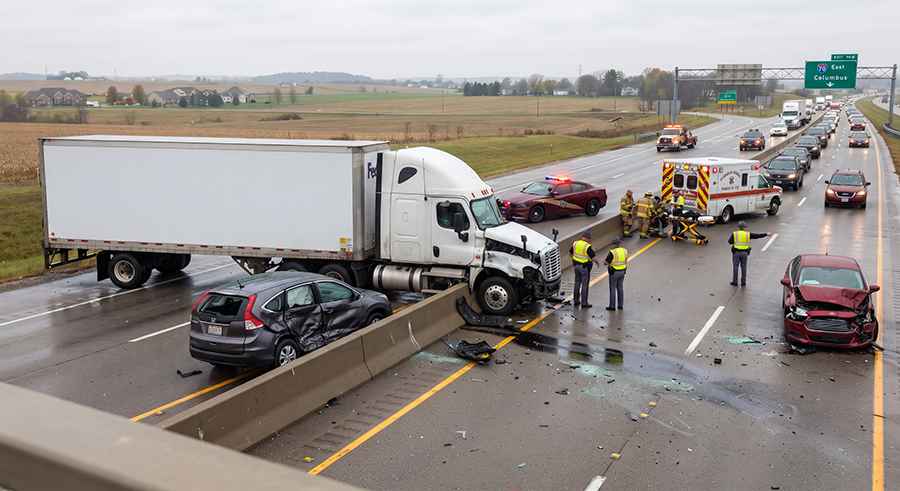
A semi-truck crash may leave you with serious injuries and a trucking company working against you. An Ohio truck accident lawyer may handle the insurers and protect evidence while you heal. If you wait, driver logs and black box data may be overwritten or lost for good.
Key Takeaways
- Yes, there are truck accident lawyers who focus on crashes involving large commercial trucks.
- A truck accident claim may involve multiple parties besides the truck driver, and each may share fault.
- Ohio gives most injured people two years to file a truck accident claim under R.C. 2305.10.
- Black box data and driver logs may disappear quickly unless someone acts to preserve them.
- Under R.C. 2315.33, you may still seek compensation if you are 50% or less at fault.
- You may be able to recover both economic and non-economic damages after a truck crash.
- Surviving family members may bring a wrongful death claim within two years under R.C. 2125.02.
- Many truck accident lawyers work on a contingency fee basis, and case costs may still apply.
- Before you hire anyone, check bar standing and trial experience, and talk with more than one lawyer.
Yes, There Are Truck Accident Lawyers in Ohio
Truck accident lawyers are personal injury attorneys who handle crashes with large commercial trucks. Trucking cases usually involve specialized rules, federal regulations and corporate defendants. Many truck accident attorneys know how the trucking industry handles claims after a serious accident.
The National Safety Council reports that 5,340 people died in large-truck crashes in 2024. About 70% of them were occupants of other vehicles, such as a passenger car. Another 161,201 people were injured, and most were in other vehicles.
An experienced truck accident lawyer may handle tasks like these:
- Insurers: calls, recorded statement requests, and settlement offers from insurance companies
- Evidence: driver logs, black box data, and maintenance records
- Experts: accident reconstructionists and medical experts
- Regulations: state and federal regulations that apply to the driver and carrier
- Deadlines: court filings made on time under Ohio law
- Legal process: each step of the claim, from investigation to trial if needed
Truck crashes come down to negligence, but more of the proof is held in company records.
Who May Be Liable After a Truck Crash
A truck accident claim may involve more than the driver. Several people and companies tied to the truck may share the blame.
- Truck driver: speeding, distracted driving, driver fatigue, or other driver error
- Trucking company: the driver's employer, which may answer for the driver's conduct on the job
- Maintenance provider: brake work or inspections done poorly
- Cargo loader: freight loaded too heavily or not properly secured
- Manufacturer: a defective truck part
A trucking company may also be liable for poor driver training or hiring.
A 2007 federal analysis of the Large Truck Crash Causation Study looked at serious truck crashes. Brake problems were coded for 29% of the large trucks in the study. Other factors found in the study's crashes included:
- Traffic flow interruptions, such as congestion or an earlier crash
- Speeds too fast for conditions
- Driver fatigue
- Work pressure from the carrier
Federal rules set minimum liability insurance for motor carriers under 49 C.F.R. 387.9. For-hire carriers hauling non-hazardous freight across state lines must carry at least $750,000. Carriers hauling certain hazardous materials must carry more.
Negligent parties may each carry their own policy. A lawyer may look closely at every one of the parties involved. If one party is overlooked, an available source of insurance coverage may be missed.
Ohio Truck Accident Law and Filing Deadlines
Ohio gives most injured people two years to file a personal injury claim. R.C. 2305.10 sets this deadline for most personal injury claims, including truck crashes. Miss it, and a court may dismiss your case no matter how strong it is.
Federal trucking regulations also apply in Ohio. The Public Utilities Commission of Ohio adopts federal motor carrier safety rules through Ohio Adm.Code 4901:2-5-03. The rules Ohio adopts cover:
- Hours of service: limits set by the Federal Motor Carrier Safety Administration (FMCSA). A property-carrying driver gets up to 11 hours behind the wheel. The clock resets after 10 straight hours off duty.
- Maintenance: inspection and repair standards for commercial vehicles
- Driver qualifications: licensing and medical standards
With some exceptions, the rule covers carriers that stay in Ohio and those that cross state lines. Truck drivers must also obey Ohio traffic laws, like speed limits and lane rules. A broken safety rule or traffic violation may help prove the truck driver was at fault.
Truck Accident Evidence Can Disappear Fast
Federal rules require many motor carriers to use electronic logging devices under 49 C.F.R. 395.8. The same rule requires carriers to keep duty records for at least six months. Many trucks also store speed and braking data in an onboard computer, commonly called a black box.
A trucking company may overwrite or discard records under its normal retention schedule. A lawyer may send a preservation letter soon after the crash. Some people call it a spoliation letter. It puts the trucking company on notice to keep its records.
Because some records only need to be kept for six months, an early call to a lawyer may help.
If you are able, the steps below may help protect your claim:
- Call 911 and report the crash.
- Seek medical attention, even if you feel fine or your injuries seem minor.
- Take photos of the accident scene and every vehicle.
- Write down when and where the accident occurred.
- Get names and phone numbers from witnesses.
- Get a copy of the police report. Many Ohio crash reports can be searched through the Ohio Department of Public Safety.
- Do not admit fault at the scene or to any insurer.
Determining Fault Under Ohio Law
Fault may become the main dispute in truck accident cases. Trucking companies and insurers may try to blame the injured driver to lower what they pay. Ohio uses a modified comparative fault rule under R.C. 2315.33. You may still recover compensation if you are 50% or less at fault.
Your award is reduced by your share of fault. Say a jury finds you 20% at fault for a rear-end collision. Your damages would then drop by 20%.
If you are found more than 50% at fault, Ohio law bars recovery. Truck records may show what the truck driver did before impact. The records may help you push back on unfair blame.
Compensation in a Truck Accident Claim
Accidents involving tractor-trailers and other large trucks may cause severe injuries. Traumatic brain injuries and spinal cord damage may require long-term care. Debilitating injuries may keep a person out of work for months and drive up medical costs.
Ohio law separates damages into two types:
- Economic damages: medical bills, future medical expenses, lost wages, and property damage
- Non-economic damages: pain and suffering, mental anguish, and loss of companionship
R.C. 2315.18 places no cap on economic damages. Non-economic damages are capped in most cases at the greater of $250,000 or three times economic loss. The cap tops out at $350,000 per plaintiff or $500,000 per occurrence.
The same statute removes the cap for certain permanent injuries:
- Permanent and substantial physical deformity
- Loss of use of a limb
- Loss of a bodily organ system
- Permanent injury that keeps a person from caring for themselves and doing life-sustaining activities
An early insurance offer may fall short of fair compensation. If the insurer will not make a reasonable offer, filing a lawsuit may be the next step. No lawyer can promise maximum or full compensation. What a claim is worth depends on the injuries sustained and the proof.
Wrongful Death Claims After a Truck Wreck
When a truck crash takes a life, surviving family members may bring a wrongful death claim. Under R.C. 2125.02, the personal representative of the estate files the case. Under R.C. 2125.02(F)(1), the claim must usually be filed within two years after the death.
The claim is for the benefit of:
- Surviving spouse
- Children
- Parents
- Other next of kin
Damages may include:
- Support: the person's expected earnings
- Services: help the person gave the household
- Companionship: loss of care, guidance, and society
- Mental anguish: grief suffered by the family
- Inheritance: money the heirs could have expected to inherit
- Funeral costs: reasonable funeral and burial expenses
Under R.C. 2125.02(E), wrongful death settlements generally require court approval.
Under R.C. 2315.18(H)(3), Ohio's non-economic damages cap does not apply to wrongful death actions.
How a Contingency Fee Basis Works
Worry about cost keeps some families from calling a lawyer. Many truck accident attorneys work on a contingency fee basis. You pay no attorney fee up front.
Under the agreement, injured clients pay the lawyer a percentage of any money recovered. If there is no recovery, you usually owe no attorney fee. Clients may be responsible for case costs and expenses, regardless of outcome.
Consultations are usually free. At that meeting, ask how the fee works and who pays costs like expert bills.
How to Vet a Truck Accident Lawyer
Not every personal injury lawyer handles commercial trucking cases. Before you sign, check a few things:
- Bar standing: look up the lawyer in the Supreme Court of Ohio Attorney Directory
- Trial experience: ask how many trucking cases the lawyer has taken to trial
- Trucking knowledge: ask about federal regulations and black box evidence
- Resources: ask who pays for reconstruction and medical experts
- Communication: ask who on the legal team will handle your case day to day
- Board certification: be careful with claims of board certification in personal injury law, because Ohio's state bar program does not certify lawyers in that area.
Talk with more than one lawyer before you decide. Pay attention to how each lawyer explains your legal options, including the weak points of your case. Be careful with a claim of board certification in personal injury law, because the Ohio State Bar Association's accredited specialization program does not certify lawyers in that area. If a lawyer claims a certification, ask which accredited organization granted it.
Frequently Asked Questions
Can I file a truck accident claim if I was a passenger?
Yes. A passenger may be able to recover compensation from any at-fault driver, including the truck driver. In some cases, that could include the driver of the car you were riding in.
What if I did not feel hurt until days after the crash?
Some truck accident injuries, such as concussions, may not show symptoms right away. See a doctor as soon as you notice pain or other changes. A gap in treatment may give the insurer a reason to question your claim.
Should I give a recorded statement to the trucking company's insurer?
You generally do not have to give a recorded statement to the other side's insurer. Anything you say may be used to shift blame onto you. Your auto policy may require you to cooperate with your own insurer, so read it closely.
Who pays my medical bills while the claim is pending?
Your health insurance or the medical payments coverage on your auto policy may pay first. Either insurer may ask to be paid back from any settlement. A lawyer may be able to negotiate that repayment.
Does the two-year deadline ever change in Ohio?
In some cases, yes. Under R.C. 2305.16, a minor's two-year clock generally does not start until the child turns 18. The same statute may pause the deadline in limited cases for a person of unsound mind, such as one a court has adjudicated that way. Talk to a lawyer before you assume you have extra time.
What if the truck driver was an independent contractor?
The trucking company may still be responsible. Under 49 C.F.R. 390.5T, the federal definition of employee includes an independent contractor driving a commercial vehicle. In some cases, that rule may help a claim reach the carrier's insurance.
How long does a truck accident claim take?
A personal injury claim has no set timeline. A claim may take longer when injuries are severe or fault is disputed. A lawyer may wait until your doctor can estimate future care before discussing a settlement.
Will my case go to trial if a lawsuit is filed?
Not necessarily. A case may still settle after a lawsuit is filed, even close to the trial date. Once a case is filed, your lawyer may formally request records from the trucking company and other defendants under Ohio Civil Rule 34.
This article is general information, not legal advice for your situation.