The Terrifying Physics of a Trailer That Starts Steering the Truck
You're driving along a Phoenix freeway when a loaded semi ahead suddenly twists. The cab veers one way, the trailer swings the other, and in a heartbeat the whole rig forms a sharp V across the entire road. It looks almost physically impossible.
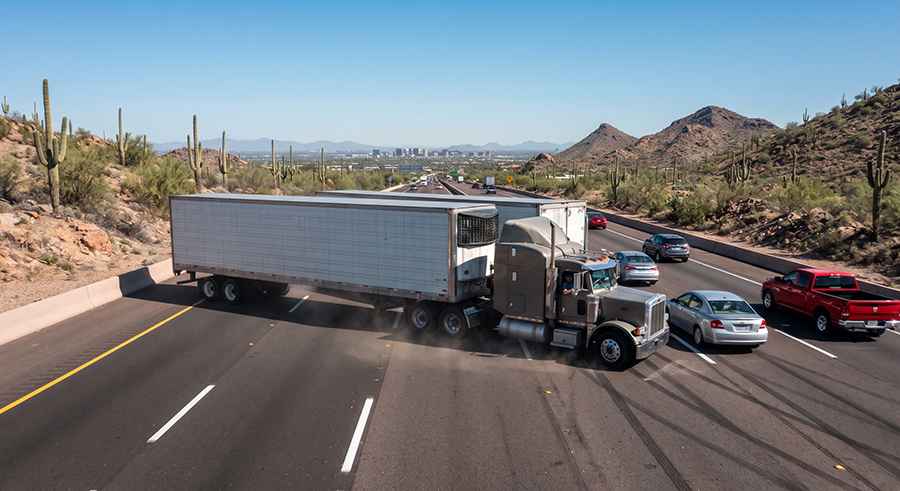
What's happening is a kind of mechanical rebellion. The trailer, which is supposed to follow obediently behind the tractor, starts pushing and steering the whole rig instead. It's a startling reversal. Tens of thousands of pounds suddenly have a mind of their own.
For the truck driver, it can feel like losing a tug of war in slow motion. Once the trailer's momentum takes over, regaining control is incredibly difficult, sometimes impossible. And for everyone else on the road, the next few seconds can become truly terrifying.
Why a Trailer Can Suddenly Move Out of Alignment
A tractor-trailer bends at one point, the hitch. That flexibility, called articulation, is what lets big rigs turn corners. Normally the trailer tracks neatly behind the tractor, but that same pivot point becomes a weakness when things go wrong. Pivot points cut both ways.
Braking forces are often the trigger behind jackknife accidents. If the tractor slows faster than the trailer, the trailer keeps pushing forward. When wheels lock or lose traction, that push can rotate the tractor and swing the trailer sharply sideways.
Traction loss is the other key ingredient. Tires need grip to keep each part of the rig moving straight. Once grip disappears, even briefly, nothing stops the trailer from swinging. Anti-lock brakes, required on new trailers since the late 1990s, help but can't prevent every jackknife.
The Strange Physics of a Truck Folding Like a Pocketknife
Momentum is the driving force. A heavily loaded trailer wants to keep moving in a straight line at the same speed. When the tractor slows or changes direction, that momentum doesn't simply disappear. It pushes forward against the hitch. Inertia is stubborn.
Friction decides who wins. If the tractor's drive wheels lose grip, the trailer's push can spin the tractor around the pivot point. If the trailer's wheels lock instead, the trailer itself can slide sideways while the tractor continues forward. It's a contest of grip.
Either way, the angle between tractor and trailer grows sharper and sharper. Each degree of rotation makes the next degree easier, a kind of dangerous runaway feedback loop. Within seconds, the whole rig can fold so tightly that the trailer nearly touches the cab.
Why Slippery Roads and Sudden Braking Make Things Worse
Reduced traction makes everything harder. In Phoenix, the first rain after a long dry spell can lift oil and dust from the pavement, creating a surprisingly slick surface. Wet roads can cut available grip dramatically compared to dry pavement. Monsoon season adds risk.
Abrupt maneuvers raise the risk too. A sudden swerve to avoid debris, a hard brake when traffic stops, or a sharp turn taken too fast can upset the balance between tractor and trailer. Smooth inputs give the tires a better chance to hold.
Uneven braking can also cause instability. Poorly adjusted brakes might grab harder on one axle or one side, pulling the rig out of line. Lightly loaded or empty trailers are especially prone to skidding because there's less weight pressing their tires to the road.
How One Jackknifing Trailer Can Block an Entire Highway
A jackknifed trailer can stretch across several busy lanes in an instant. Drivers approaching from behind may suddenly face a solid wall of steel with no open path, often with only a second or two to react before impact. There's simply nowhere to go.
Nearby vehicles can be struck directly by the swinging trailer. Cars in adjacent lanes may be sideswiped, pushed into other lanes, or crushed against barriers. Motorcycles and smaller vehicles are especially vulnerable to the sheer size and force involved. Mass matters enormously here.
The danger continues after the rig stops. With lanes blocked, approaching drivers may rear-end stopped traffic or swerve into other vehicles. Spilled cargo, leaking diesel fuel, and debris can create additional hazards, and secondary crashes can keep happening long after the first collision.
Conclusion
A jackknife turns a trailer from an obedient follower into a force that steers the whole truck. Braking forces, lost traction, and the trailer's momentum can combine in mere seconds to fold a heavy tractor-trailer sharply at its hitch. It happens frighteningly fast.
Slippery pavement, sudden maneuvers, uneven braking, and lightly loaded trailers all significantly increase the risk. Once a trailer swings out, it can block multiple lanes, strike nearby vehicles, and set off a cascade of secondary crashes that put many innocent people in danger.
Preventing jackknifes starts long before a crisis. Proper, smooth braking technique, well-maintained equipment, balanced cargo, safe speeds, and extra caution in bad weather all help keep trailers in line. When trucking companies and drivers get those basics right, the trailer stays where it belongs.