The Visibility Gap on Remote Roads: What Thermal Cameras Can Do for You
Driving on remote highways or rural roads at night —away from city lights and well-lit infrastructure, drivers face a severe "visibility gap" where standard headlights and human eyes simply aren't enough. When safety hazards hide in the shadows, thermal technology transforms how you perceive the road ahead.
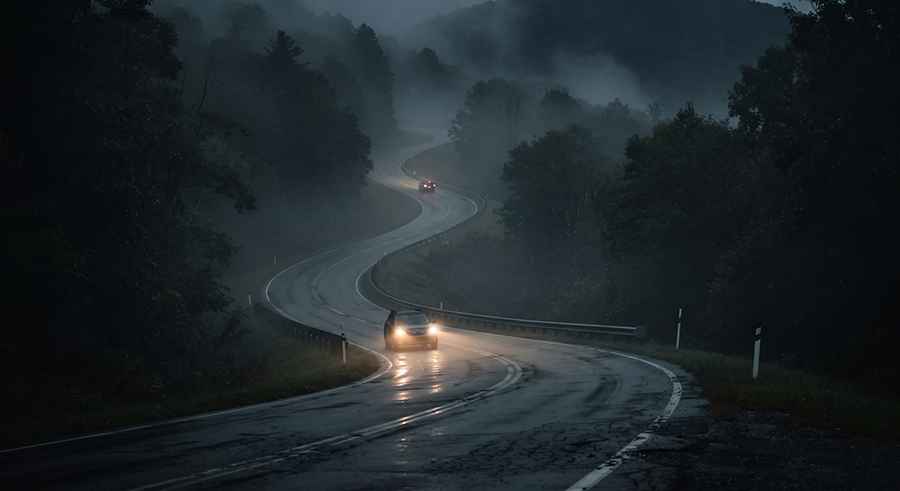
1. The Hidden Dangers: Darkness, Fog, Dust, and Wildlife
The primary cause of nighttime and rural road accidents isn't just dark skies—it's impaired visibility caused by natural elements:
Dense Fog and Heavy Dust: Particles in the air scatter light from high beams, creating a blinding "wall of white" that reflects light back at the driver rather than illuminating the road.
Camouflaged Hazards and Sudden Wildlife: Deer, livestock, and unlit static obstacles seamlessly blend into dark tree lines and dusty margins. By the time high beams illuminate an animal stepping into your lane, stopping distances are often too short to prevent a high-impact collision.
2. The Isolation Factor: No Witnesses, No Signal, No Proof
When an incident occurs on an isolated stretches of road, the challenge extends far beyond the immediate shock of an accident:
Zero Local Coverage: Many rural corridors lack cellular service, leaving drivers stranded without immediate emergency assistance or real-time location streaming.
Absence of Eyewitnesses: Without passing traffic or nearby security systems, determining fault in collisions or disputes with wild animals becomes your word against an empty road.
The Need for Absolute Proof: Having an undeniable, reliable photographic and video record saved directly on board is your only line of defense for insurance claims and police reports.
3. Bridging the Gap: Pilot 2
Solving the visibility gap requires a dual-technology approach: pairing high-definition optical lenses with long-range thermal detection. This is where the Pilot 2 (P2) stands out as the absolute ultimate choice for remote driving.
Unlike standard dash cams that rely solely on visible light, the Pilot 2 integrates a dedicated thermal imaging module alongside optical lenses. It pierces through blinding fog, dense dust, and total darkness by detecting heat signatures rather than light reflections, flagging living obstacles long before they enter your headlight beam.
4. Inside the Pilot 2: Camera Breakdown and System Role
To understand how the Pilot 2 protects you on isolated routes, here is a detailed breakdown of what each lens sees and how the overall system operates.
Camera Module | What It Detects | Key Practical Function |
Thermal Imaging Camera | Thermal signatures / Infrared heat emitted by organisms & vehicles | Cuts through dense fog, dust, and total darkness; highlights animals, pedestrians, and warm vehicles hundreds of feet away. Feeds real-time thermal video directly to Apple CarPlay for live dashboard monitoring. |
Front Camera | Full color HD video, street markings, license plates, visible signals | Captures rich visual context and road details when lit by headlights or daytime conditions. |
Cabin / Interior Camera | Inside passenger space activity, cabin conditions | Documents interior driving conditions and provides passenger safety recording. |
Rear Camera | Vehicles approaching from behind, tailgating, rear-end impacts | Secures 360-degree surrounding evidence around the entire perimeter of the vehicle. |
The Role of the Pilot 2 Dash Cam
The Pilot 2 acts as your intelligent co-pilot and automated witness:
Early Hazard Detection: The thermal engine identifies heat signatures invisible to the naked eye, offering vital extra seconds to brake or safely steer clear of crossing wildlife.
Continuous Perimeter Evidence: While the thermal lens scans ahead for invisible dangers, the optical multi-channel system continuously logs high-definition evidence from every angle around your car.
Local Off-Grid Reliability: Storing high-bitrate video directly to onboard memory ensures that even without cell signal or network connections, your critical trip data and accident evidence remain securely saved.
Conclusion
Navigating unlit, low-visibility remote routes shouldn't mean driving blind to what lies ahead. By bridging the critical gap between ambient light and thermal radiation, the Pilot 2 (P2) delivers unmatched situational awareness when you need it most. Combining thermal heat vision with comprehensive multi-angle optical recording, the Pilot 2 stands as the definitive choice for rural motorists, overlanders, and long-distance drivers seeking absolute confidence on every mile of the open road.