Winter Tires for Nissan Rogue: What AWD Owners Should Know
An all-wheel-drive Nissan Rogue still needs winter tires if it spends the cold months on snow, slush or ice. The Intelligent AWD system can move torque to the wheels that have grip, which helps the SUV pull away from a stop sign without spinning.
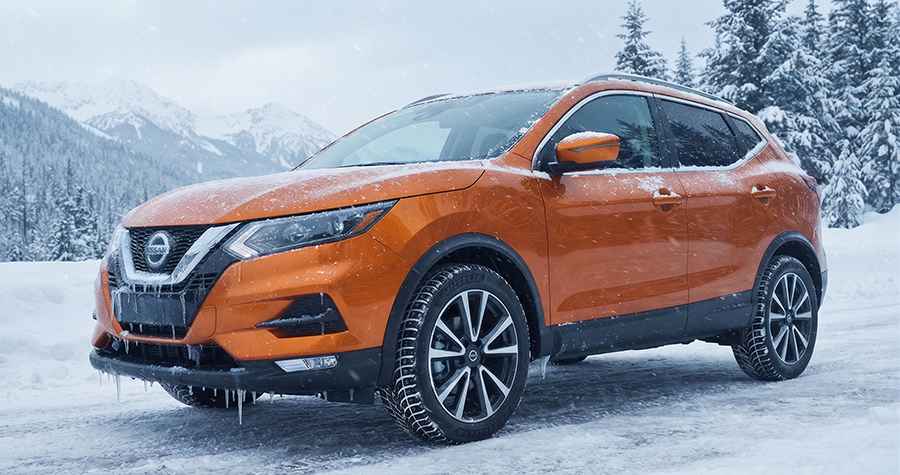
Braking and cornering are a different story: how quickly the Rogue stops and how well the front end holds a turn depend on the tires, not the drivetrain. A matched set of four winter tires, in the right size and fitted before temperatures settle below about 45°F, gives the Rogue’s AWD the traction it was built to manage.
Why AWD alone isn’t enough for a Nissan Rogue in winter
The Rogue’s system drives mostly through the front wheels and sends power to the rear when it senses slip, with a split that can reach 50:50. AWD trims also get a Snow mode that softens throttle response. On a slippery incline, that combination works well. But AWD helps a Rogue accelerate, not stop or steer, and every car on the road brakes with all four wheels anyway. Plenty of owners find this out on the first icy morning: the SUV gets up to speed with no fuss, and the missing grip shows up only when it’s time to slow down for a red light.
Timing matters as much as the tires themselves. Drivers in Chicago’s north suburbs tend to plan the swap early, and lining up Nissan tire service in Skokie in October usually beats the rush that follows the first heavy snowfall. Old Orchard Nissan sits on Golf Road just off the Edens Expressway and services Rogues for owners from Evanston, Wilmette, Niles and nearby towns, where a winter commute can mix dry pavement, slush and black ice in a single trip.
How winter tires change the Rogue’s behavior on snow
Rubber that stays soft in the cold
All-season compounds start to stiffen as temperatures drop toward freezing. Winter tires use a softer, silica-rich compound that keeps flexing well below 32°F. On a Rogue, the gain is most obvious under braking and in how rarely stability control has to step in, since the tires slip less to begin with.
Tread built to bite
Deep grooves and thousands of small slits, called sipes, give the tire extra edges to grab packed snow and ice. The open tread also holds snow inside the grooves, and snow grips snow better than rubber does. The three-peak mountain snowflake (3PMSF) symbol on the sidewall marks tires that passed a standardized snow traction test.
Choosing winter tire sizes for your Nissan Rogue
Recent Rogues use three factory wheel sizes. On 2024–2026 models, the S and Rock Creek ride on 17-inch wheels with 235/65R17 tires, the SV steps up to 18 inches with 235/60R18, and the SL, Platinum and Dark Armor wear 19-inch wheels with 235/55R19 tires. Some listings show 225-width tires for the S and Rock Creek, so the placard on the driver’s door jamb should always have the final word.
Owners of 18- and 19-inch trims often switch to 17-inch wheels for winter. The taller sidewall handles potholes better, keeps expensive alloys away from curbs and salt, and 17-inch winter tires usually cost less than 19-inch ones. Overall diameter stays close to stock, so the speedometer reads correctly and the AWD system sees no difference. Since the S trim already rides on 17s, these wheels generally clear the brakes on the same generation, though fitment should still be confirmed before buying.
Studless, studded or all-weather: options for Rogue owners
Studless winter tires suit drivers who deal with regular snow, ice and steady cold, and their only real drawback is that they have to come off in spring. Studded tires bite hardest on long stretches of rural ice, but they are noisy, wear down pavement and are illegal for most drivers in Illinois. All-weather tires carrying the 3PMSF mark work for mild winters with occasional snow and can stay on all year, though their grip on ice falls short of a true winter tire.
For most suburban and city drivers, studless winter tires make the most sense. Their ice grip is close enough to studs for daily commuting, and they skip the noise and the legal trouble.
Winter tire setup checklist for AWD owners
- Always mount winter tires in a set of four. Mismatched tread depth or compounds front to rear keeps the AWD coupling working constantly and can unsettle the car under hard braking.
- Plan for TPMS. A second set of wheels needs its own sensors, or the warning light will stay on all season.
- Install the tires when daytime highs stay under about 45°F, typically by mid-November in northern Illinois, and take them off once spring temperatures hold above that mark.
- Check pressure every two weeks. Tires lose roughly 1 psi for every 10°F drop, and the correct figure is on the door placard, not the sidewall.
- For snow use, replace winter tires once tread reaches about 6/32 inch, since their grip on packed snow falls off quickly past that point.
- Store the off-season set in a cool, dark place, stacked flat if mounted on wheels.
What a Rogue AWD really needs for winter
For a Rogue AWD that faces Midwest-style winters, the best setup is a dedicated set of studless 3PMSF winter tires, ideally on separate 17-inch wheels with their own TPMS sensors, mounted in mid-November and removed in spring. Owners in regions that see snow only a few days a year can reasonably run all-weather 3PMSF tires year-round instead. The weakest option is AWD on worn all-season tires: the SUV launches without trouble, then needs far more road to stop on ice than its driver expects. Before the first freeze, three checks cover most of the risk: the tire size on the door placard, the remaining tread on last winter’s set, and working TPMS sensors in the spare wheels.