High Altitude and Long Descents: Why the Cooling System Fails First
The roads that make dangerous-road lists share the same demands on a vehicle: a long climb, thin air, a stretch of switchbacks, and a descent that seems to last forever. Drivers usually worry about brakes and tires. The cooling system is often the first thing to show a problem, and it tends to do so when you're far from help.
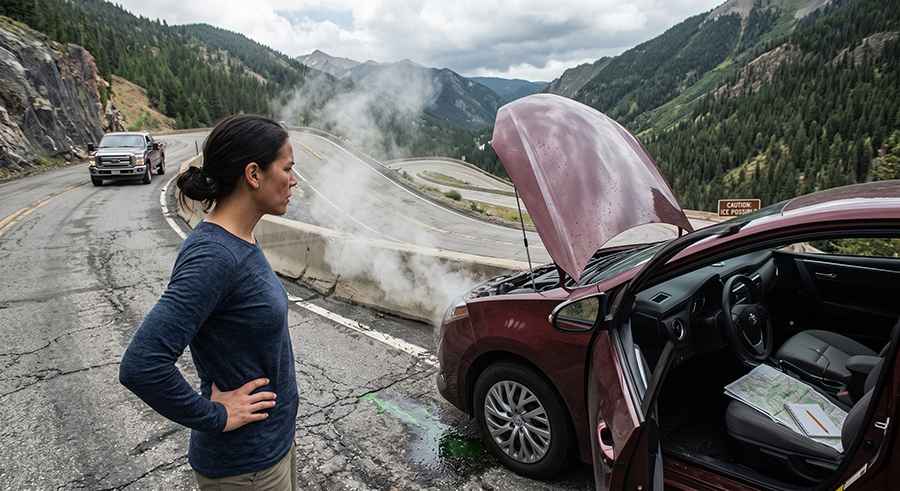
This guide covers why the cooling system is under so much stress on mountain routes, what the early warning signs look like, and what to check before you leave.
Why Mountain Driving Is Hard on Cooling
Climbs load the engine for a long time. A system at or near its working limit for tens of minutes.That is very different from city driving or flat highway cruising. A loaded diesel pickup or a truck towing a trailer sits in that zone almost the entire climb.
Thin air changes the margins. At altitude, air is less dense, so the radiator moves less heat for the same airflow. Coolant also boils at a lower temperature as atmospheric pressure drops. The cap and the pressurized system compensate for this, but only if every hose, clamp, cap, and joint is holding pressure properly.
Descents keep the load on. Many drivers assume the engine can cool off on the way down. If you are in a low gear and using engine braking, the engine is still working, and heat keeps building in the system while you are focused on speed and corners. Diesel trucks with exhaust brakes have more heat to manage.
Temperature swings punish old parts. Cold mornings and hot afternoons make rubber, plastic, and metal expand and contract again and again. Hoses harden, clamhat were fine in town begin to seep.
The Early Warning Signs
A cooling problem rarely arrives without not
- The temperature gauge sits higher than usual on the same climb, or climbs faster than it used to.
- Coolant level drops between fill-ups with no visible puddle. A slow loss can mean a small leak that only shows when the system is hot and pressurized.
- Dried residue or crust around hose ends, joints, or fittings. Dried coolant often leaves a white, green, or orange trace.
- A sweet smell after a hard drive. This is often coolant vaporizing on a hot surface.
- Damp spots under the truck after a long stop, even a small one.
- A hose that feels soft, swollen, or brittle when you squeeze it on a cold engine.
If you see any of these before a mountain trip, deal with it first. A small seep at sea level can become a real leak after hours of climbing and descending.
A Pre-Trip Cooling Check
Do this on a cold engine, a few days before you leave, so you have time to fix what you find.
- Coolant level and condition. Check the reservoir and radiator level against the marks. The coolant should be clean, not rusty or oily.
- Squeeze them along their length. Cracks, bulges, or a hard, shiny surface are reasons to replace.
- Clamps and connections. Check that clamps are in place and snug, and look at every joint for crust or staining.
- Radiator and cap. Look for bent fins or dep should seal; a weak cap lowers the pressure the system can hold.
- Fan and belt. Make sure the fan engages and the belt is not glazed or frayed.
- Pressure test, if you can. A shop can pressure-test the system and find seeps that are hard to see by eye.
Know the Weak Points on Your Platform
Every engine has a few places where trouble tends to start, and it pays to learn yours before the trip, not on the shoulder. Owners of 2010s Ram trucks with the 6.7L Cummins, for example, often point to the coolant connections near the hoses as a spot that starts to weep with age. It's easy to miss in the driveway and a lot harder to ignore at 10,000 feet.
If yours is showing a damp or crusty joint, deal with it now. Look up the parts for your exact model year the6.7L Cummins parts for 2013–2018 Rams are one place to start, and match the year and engine before you order. Then recheck the joint after a short drive to make sure it's dry.
On the Road: What to Do If the Gauge Climbs
- Don't ignore it. Ease off the load, reduce speed, and find a safe place to stop.
- Let the engine idle briefly rather than shutting it off at once on a hot run. This lets coolant keep circulating.
- Never open a hot radiator or reservoir cape and the coolant can cause serious burns.Wait until it has cooled fully.
- Carry water or pre-mixed coolant so you can top off once the engine is cool.
- Keep basic supplies: a spare hose or clamp if your platform needs them, a few hand tools, gloves, and a flashlight.
- Know your next stop. On remote routes, fuel and repair shops can be hours apart. Plan where you can pull over, not just where you want to be.
The Takeaway
Mountain roads are hard on cooling systems because of the long climbs, thin air, and heat that keeps building on the way down. The good news is that most failures give warning signs and can be prevented with a careful check before you leave. Inspect your hoses, joints, and coolant, fix small seeps now, and carry the basics for the road. A few hours in the driveway can keep a spectacular trip from becoming a roadside breakdown.